
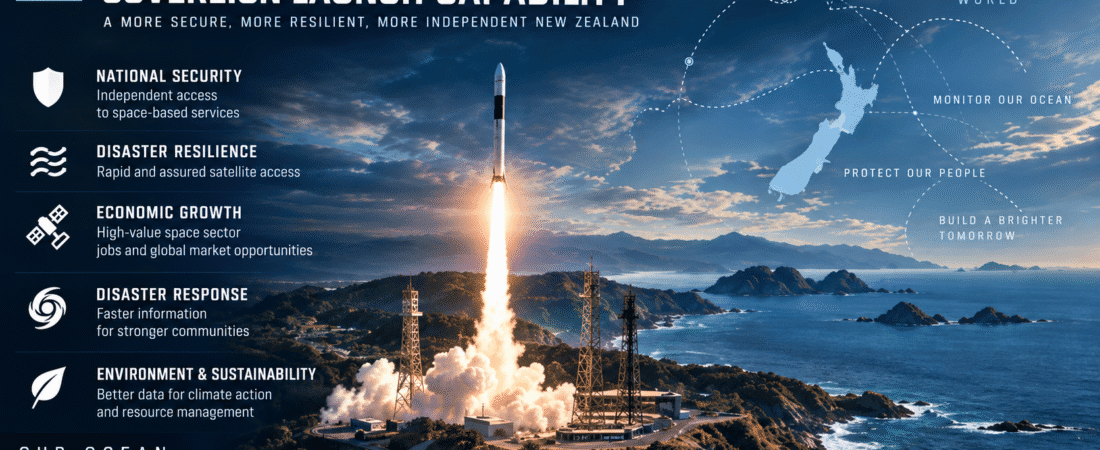
New Zealand does not need to become a global rocket superpower. It does need the ability to launch from its own territory, for its own priorities, without depending entirely on commercial providers or foreign strategic decisions.
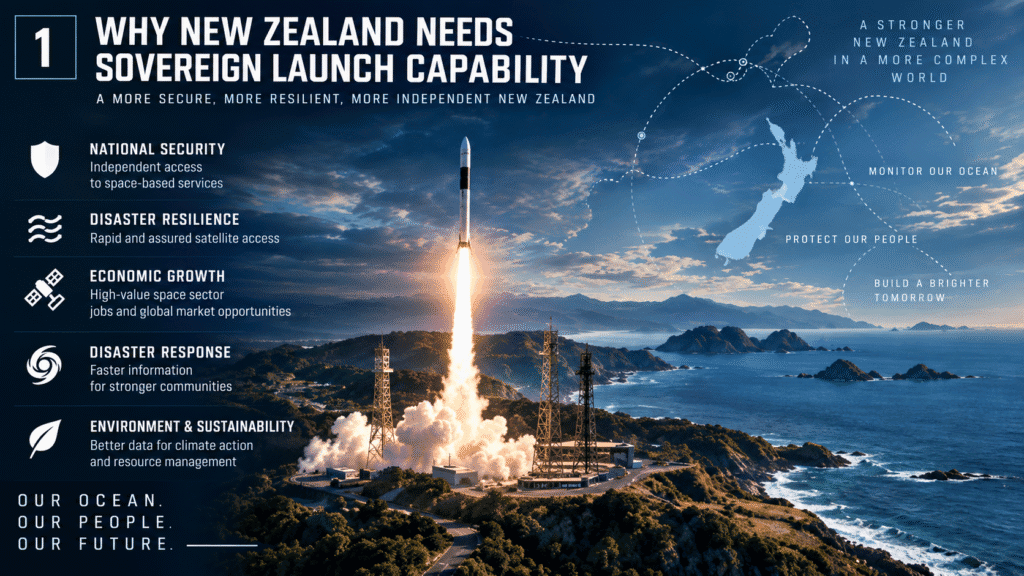
Space access is increasingly becoming part of national infrastructure.
Satellites support communications, maritime awareness, disaster response, navigation, environmental monitoring and defence. As reusable launch technology matures and launch operations become more routine, the strategic importance of controlling access to orbit is likely to increase rather than decline.
For New Zealand, the key question is therefore not whether private companies can launch rockets.
The more important question is:
Who should ultimately control New Zealand’s ability to reach space when national interests are involved?
NZWAR’s view is that the answer should be clear.
New Zealand should establish a defence-led sovereign launch capability, with the military acting as the anchor investor, strategic customer and capability owner during the early stages.
Commercialisation can come later.
Sovereign capability should come first.
1. The objective is not a “New Zealand SpaceX”
A common mistake would be to frame this as an attempt to build a New Zealand equivalent of the world’s largest launch companies.
That is unnecessary.
New Zealand does not need the largest rockets, the highest launch cadence or the biggest commercial market.
It needs something much more focused:
the ability to place selected national payloads into orbit from New Zealand territory, according to New Zealand priorities.
That is a fundamentally different objective.
The value would come from strategic independence rather than commercial scale.
A modest sovereign launch capability could support missions involving:
- communications resilience,
- maritime surveillance,
- disaster-response satellites,
- environmental monitoring,
- defence-related payloads,
- technology demonstration,
- and rapid replacement of critical space assets.
For a geographically isolated country surrounded by an enormous maritime environment, even a relatively small space-launch capability could have disproportionate strategic value.
2. The existing commercial model is not enough
New Zealand already has a commercial space sector.
That is useful.
But commercial presence is not the same thing as sovereign capability.
A commercial company makes decisions according to its own economics, investors, customers and long-term business strategy.
A government makes decisions according to national interest.
Those two interests may overlap, but they are not identical.
This distinction becomes particularly important when launch access is needed during:
- an international crisis,
- a major natural disaster,
- a military emergency,
- a communications disruption,
- or a period when overseas customers are competing for limited launch capacity.
A country cannot assume that commercial availability will always equal national availability.
Nor should national strategy depend on a single company remaining financially healthy, technologically competitive and aligned with government priorities indefinitely.
This is especially important for New Zealand because its domestic launch sector remains small.
The current industry does not yet have the scale, market depth or cost structure required to carry a full sovereign space strategy by itself.
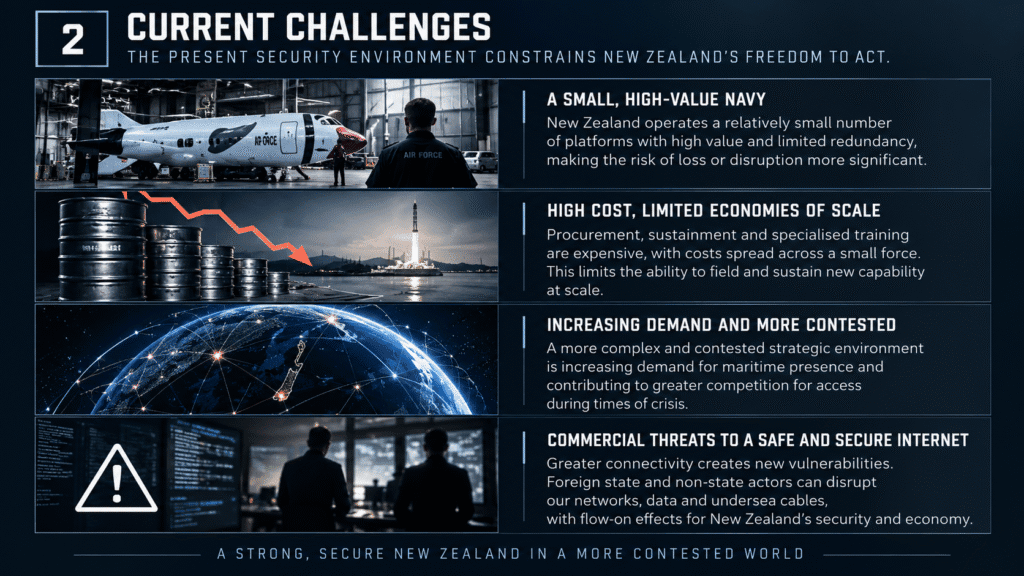
In commercial terms, purely domestic launch operations may struggle to achieve sufficient economies of scale.
That is exactly why expecting the private market to solve the problem independently may be unrealistic.
3. The military can solve the problem that the market cannot
The private sector faces one fundamental question:
Where will enough launch demand come from?
Defence does not face the same problem.
The state can create demand.
If the New Zealand Defence Force and government decide that launch capability is strategically important, they can establish a long-term mission pipeline.
That might include:
- satellite deployment,
- surveillance payloads,
- communications experiments,
- responsive-launch exercises,
- maritime-monitoring missions,
- defence technology demonstrations,
- university and research payloads,
- and government agency missions.
This transforms the economics.
Instead of asking:
“Can a New Zealand rocket company survive by finding enough customers?”
the question becomes:
“What capability does New Zealand need, and which companies should be contracted to build it?”
That is a much stronger starting point.
4. Defence should be more than a customer
Simply purchasing launches may not be enough.
If New Zealand wants genuine sovereign capability, the government needs influence over the underlying capability itself.
That means defence should consider several models.
It could:
- invest directly in domestic launch companies,
- take strategic equity stakes,
- establish joint ventures,
- fund launch infrastructure,
- own critical intellectual property or facilities,
- contract local companies to operate government-owned systems,
- or establish a dedicated defence-controlled launch entity.
The precise ownership structure is less important than one principle:
The core capability must remain available to New Zealand regardless of commercial market conditions.
This is the difference between supporting an industry and possessing a capability.
New Zealand should do both.
5. The first goal should be capability, not profitability
This is perhaps the most important policy distinction.
A sovereign launch programme should not initially be judged by the same criteria as a normal startup.
Its first objective should not be maximum commercial return.
Its first objective should be:
Does New Zealand possess a reliable domestic launch capability?
The military routinely maintains capabilities that would not make sense as standalone commercial businesses.
Air defence, naval logistics, military communications and intelligence systems exist because strategic value cannot always be measured through ordinary market profitability.
Launch capability should be considered in the same way.
Once the capability exists and becomes technically mature, the commercial question can be revisited.
But demanding immediate profitability before establishing the capability may simply guarantee that the capability never appears.
6. A defence-led programme could strengthen New Zealand companies
A defence-led model does not mean excluding private industry.
It could do the opposite.
Government procurement can provide domestic companies with something that is extremely difficult for small technology firms to obtain:
predictable long-term demand.
Defence contracts can help companies invest in:
- propulsion,
- guidance systems,
- manufacturing,
- materials,
- launch infrastructure,
- avionics,
- testing,
- and skilled personnel.
Instead of giving grants and hoping companies eventually succeed, the government can create real missions.
That creates a domestic industrial base.
Companies that prove themselves could later compete internationally.
Companies that fail would not determine whether New Zealand itself loses the strategic capability.
That distinction is crucial.
7. New Zealand should not depend on one domestic company either
Sovereignty should not mean replacing foreign dependence with dependence on a single New Zealand company.
That would simply create another vulnerability.
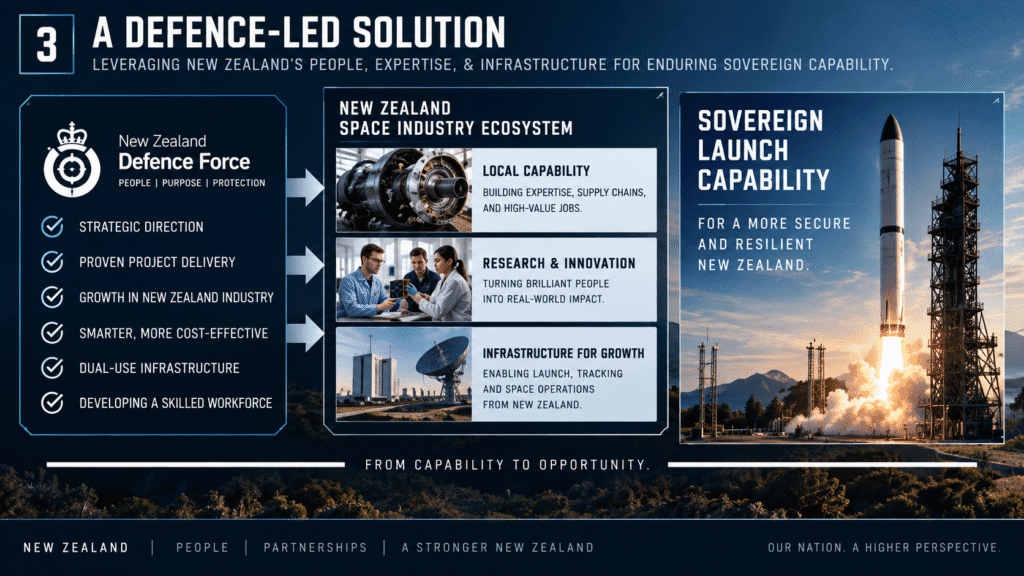
The defence programme should therefore encourage multiple suppliers where practical.
One company might develop propulsion.
Another could provide structures.
Another could specialise in avionics, software or satellite integration.
Universities could support research.
International firms could participate through partnerships.
The government would then sit above the ecosystem as the strategic customer and capability coordinator.
That creates resilience.
More importantly, it gives New Zealand bargaining power.
8. Government orders give New Zealand leverage with major international companies
This is one of the strongest arguments for defence leadership.
A small commercial startup approaching a global aerospace company has limited negotiating power.
The New Zealand Government is different.
It can offer:
- national-level contracts,
- long-term procurement,
- launch sites,
- regulatory cooperation,
- research partnerships,
- defence relationships,
- access to a Southern Hemisphere operating environment,
- and regional strategic partnerships.
That changes the conversation.
A large international aerospace company may have little reason to respond to a small private operator.
It has much more reason to respond to a government procurement programme.
This means New Zealand could use defence orders to attract major firms while still setting the terms of cooperation.
The objective would not be to surrender control.
It would be to use international technology and capital to accelerate a capability that remains anchored in New Zealand.
9. New Zealand’s geography is an asset
New Zealand has one major advantage that cannot be imported or replicated elsewhere:
geography.
It is surrounded by large ocean areas and relatively uncongested airspace compared with many highly populated regions of the world.
That creates opportunities for launch operations, testing, tracking and range safety.
It also aligns naturally with New Zealand’s strategic needs.
New Zealand must monitor large areas of ocean relative to the size of its population and defence force.
Space systems can help compensate for that imbalance.
Satellites can support:
- fisheries protection,
- maritime domain awareness,
- vessel tracking,
- disaster assessment,
- environmental monitoring,
- infrastructure observation,
- and regional security.
A sovereign launch capability therefore connects directly with one of New Zealand’s greatest strategic challenges:
how to observe and manage a very large area with a relatively small national workforce.
10. Reusable launch technology changes the long-term equation
The success of reusable launch systems has changed assumptions about how space transportation may evolve.
The important lesson for New Zealand is not that it must immediately copy the largest reusable rockets.
The lesson is that launch technology is moving toward:
- higher reuse,
- shorter turnaround,
- lower marginal cost,
- and greater launch frequency.
That trend makes early participation more important.
If New Zealand waits until launch technology becomes a fully mature global infrastructure sector, much of the industrial knowledge, supply chains and strategic relationships may already be concentrated elsewhere.
Building capability now gives New Zealand an opportunity to participate in that transition rather than becoming a permanent downstream customer.
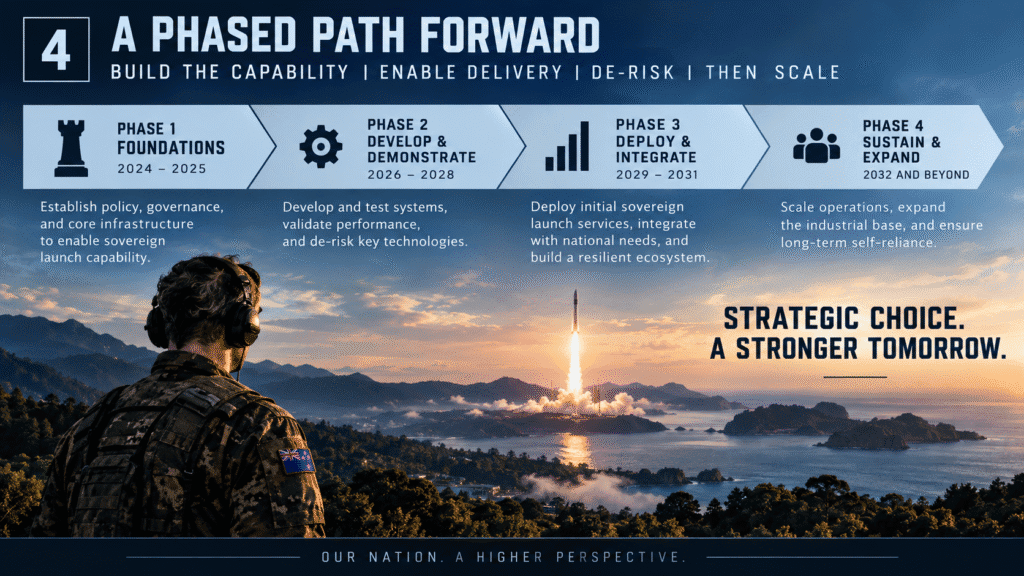
11. The programme should be phased
A defence-led launch strategy does not require New Zealand to commit immediately to one permanent industrial model.
That decision can be made later.
A sensible approach would be evolutionary.
Phase One — Establish sovereign capability
Government and defence define mission requirements.
New Zealand funds technology development, infrastructure and test programmes.
Defence becomes the anchor customer.
Strategic investment or government ownership ensures the capability cannot disappear because of short-term commercial failure.
Phase Two — Build a domestic ecosystem
Local companies compete for contracts.
Supply chains develop.
Universities and research institutions participate.
International partners may provide selected technologies and expertise.
Phase Three — Evaluate commercial viability
Once launch reliability, demand and cost become clearer, New Zealand can decide whether the system should become:
- commercially operated,
- government-owned but commercially managed,
- a public-private partnership,
- or part of a multinational launch programme.
Phase Four — Expand international cooperation
If appropriate, New Zealand could use its launch infrastructure and geographic position as leverage in partnerships with major allies and aerospace companies.
At that stage, international cooperation would be a choice.
It would not be a dependency forced by lack of domestic capability.
12. Sovereign capability creates strategic choice
Ultimately, this is not primarily an argument about rockets.
It is an argument about options.
A country with no domestic launch capability has fewer options.
It must purchase access.
It must wait for availability.
It must negotiate from a weaker position.
And during a crisis, it may discover that commercial or foreign priorities come first.
A country with sovereign capability is in a different position.
It can launch independently.
It can cooperate internationally when cooperation is advantageous.
It can use domestic firms when they are competitive.
It can invite global companies when they bring technology or scale.
And it can retain strategic control when national security requires it.
That is the real value.
Conclusion: Build the capability first. Decide the business model later.
New Zealand should not approach sovereign launch capability by asking whether a private rocket company can immediately become commercially profitable.
That puts the question backwards.
The first question should be:
Does New Zealand require independent access to space as part of its future national security and resilience?
If the answer is yes, then the state must ensure that capability exists.
The New Zealand Defence Force is the institution best placed to anchor that process because it combines strategic responsibility, long-term procurement, government authority and national-security demand.
Defence can fund local firms.
It can invest in them.
It can take strategic ownership where necessary.
It can establish its own capability if the market cannot provide one.
And it can use government procurement to attract major international aerospace companies on terms that strengthen New Zealand rather than simply turning New Zealand into another customer.
Later, when the technology and market are mature, the country can decide how much of the capability should be commercialised.
It can privatise parts of the system.
It can retain strategic ownership.
It can establish partnerships with global companies.
Or it can use a mixed model.
But those are decisions New Zealand should make after it possesses the capability.
Not before.
The strategic principle is therefore straightforward:
First establish sovereign launch capability under New Zealand control.
Then let the market determine how much of that capability can safely become commercial.
For a small maritime nation entering an increasingly space-dependent world, that is not excessive ambition.
It is strategic insurance.