THE UNCREWED
BATTLEFIELD
New Zealand’s unmanned future is larger than drones in the sky. It is a connected force spanning air, land, surface and subsurface systems — linked by sensors, communications, software and human command.
The policy environment has changed.
New Zealand is no longer discussing uncrewed systems only as small surveillance tools. Defence planning now includes persistent surveillance, counter-UAS, robotic experimentation, industrial resilience and the investigation of one-way strike capability.

NZDF already operates a limited range of aerial, surface and subsurface uncrewed systems, primarily for ISR.
Defence states that NZDF is actively experimenting with robotic ground vehicles and one-way effector drones.
A 2026 RFI examines unarmed long-range UAS for persistent maritime surveillance across the South West Pacific.
Government has begun industry engagement for human-operated, non-autonomous one-way strike systems.
Do not copy the war. Learn the method.
Ukraine demonstrated that a smaller country can accelerate capability by linking affordable machines, software, rapid iteration, industry and frontline feedback. The lesson for New Zealand is not to reproduce a continental land war. It is to adapt the method to an island nation with a vast maritime operating environment.

Iteration beats perfection
Systems change quickly. Procurement, testing, repair and software updates must be able to move faster.
Mass can come from smaller systems
Uncrewed platforms can distribute sensing, logistics and mission capacity across many nodes.
Electronic warfare changes everything
Communications, navigation and data links must be treated as contested rather than guaranteed.
Industry becomes part of readiness
Design, integration, repair and modification capacity can matter almost as much as the original platform.
One mission network. Different machines. Different roles.
A modern uncrewed force should not be imagined as a swarm of identical aircraft or as a fixed six-step formation. Different platforms may perform reconnaissance, relay, decoy, local ISR, mission-effect or assessment roles as required, while sensors, communications and operators maintain a common picture.


Air power becomes distributed.
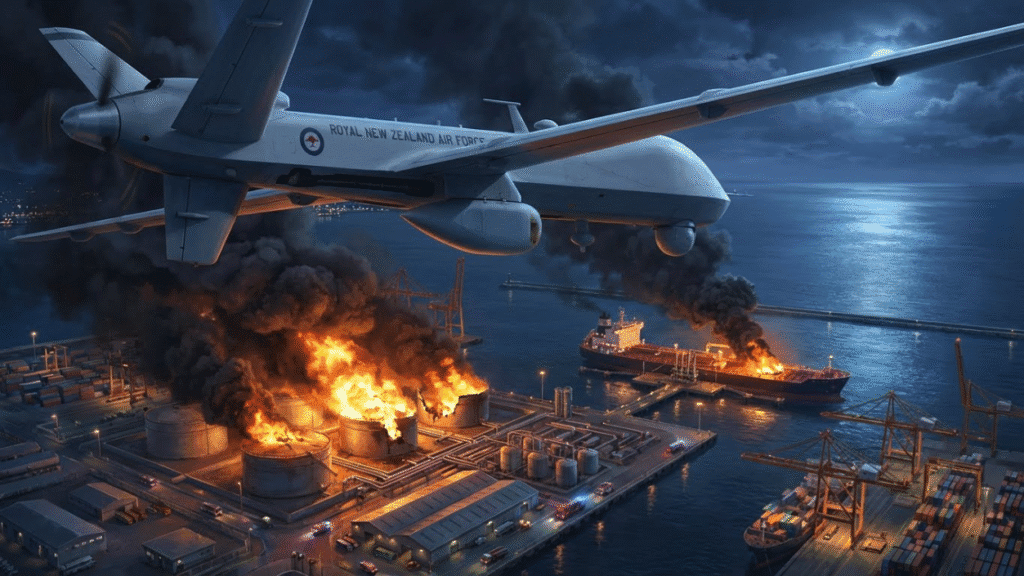
New Zealand’s geography makes endurance and coverage especially valuable. Long-range systems can complement crewed aircraft by expanding surveillance, maintaining presence for longer periods and providing additional sensing across the Pacific and Southern Ocean.


Long-range surveillance
Wide-area maritime ISR can extend the time and distance over which New Zealand monitors its approaches and regional environment.
Tactical sensing
Smaller systems can place observation closer to ships, land units, ports and remote infrastructure without assigning a crewed aircraft to every task.
Relay & communications
Airborne nodes can help connect sensors and operators across dispersed terrain and large maritime distances.
Mission systems
New Zealand is now investigating human-operated one-way systems, signalling a move beyond an ISR-only understanding of uncrewed air power.
The July 2026 long-range surveillance UAS RFI is for an unarmed system and is market research rather than a commitment to purchase. The one-way strike initiative is a separate process.

Machines take the exposed work first.
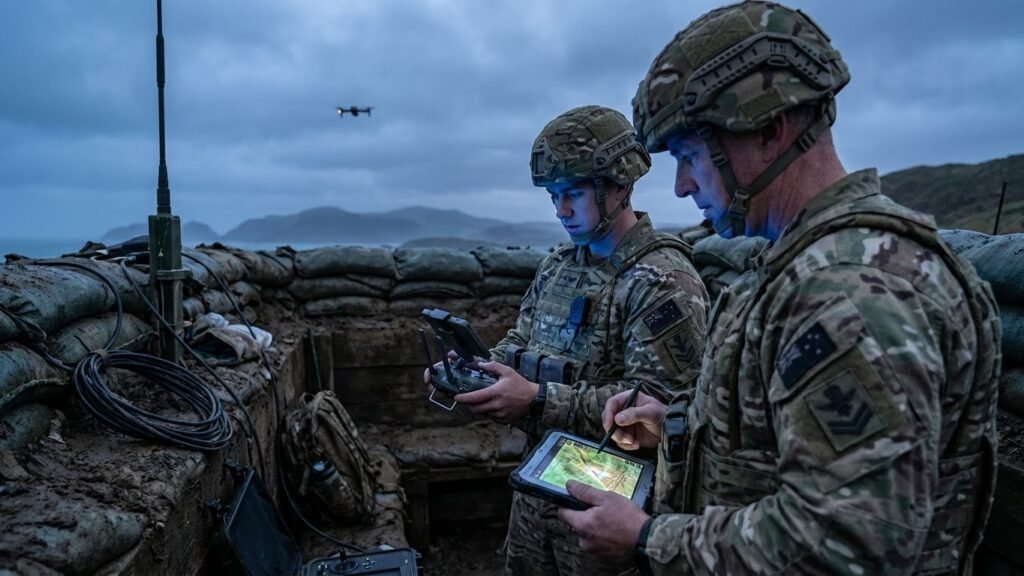
Ground robotics should not be viewed only as remotely operated combat vehicles. Their greatest value may be the large number of dangerous, repetitive and labour-intensive tasks that no longer need to place a person in the most exposed position.
NZDF has publicly stated that it is experimenting with robotic ground vehicles. For a country with limited personnel, that matters: automation can increase the work performed by each deployed team.
For New Zealand, the sea may be the decisive domain.
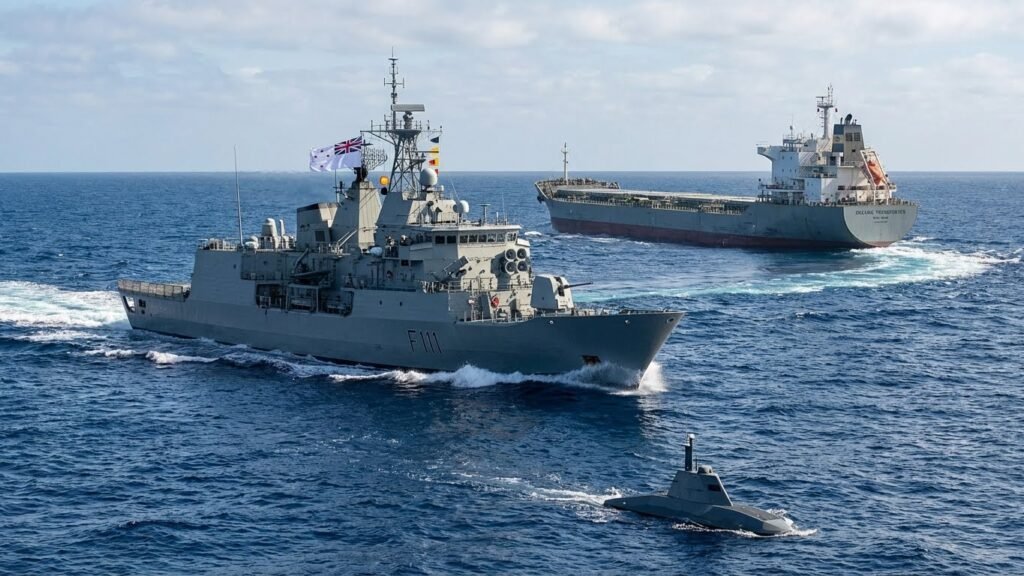
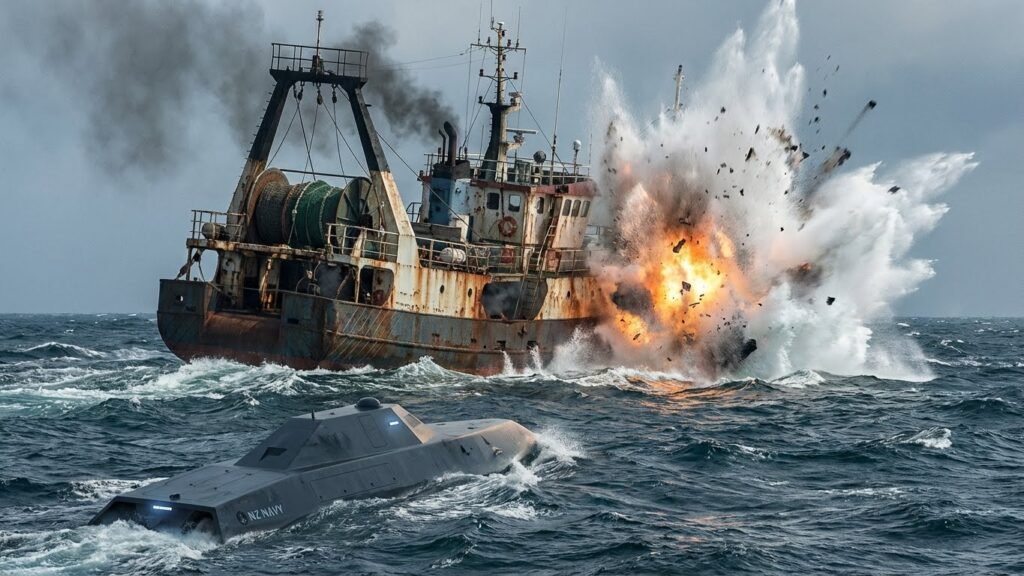
New Zealand should not simply import a land-war template. A maritime country needs persistent machines above, on and below the water, supporting surveillance, infrastructure awareness, naval operations and civil-security missions over very large distances.


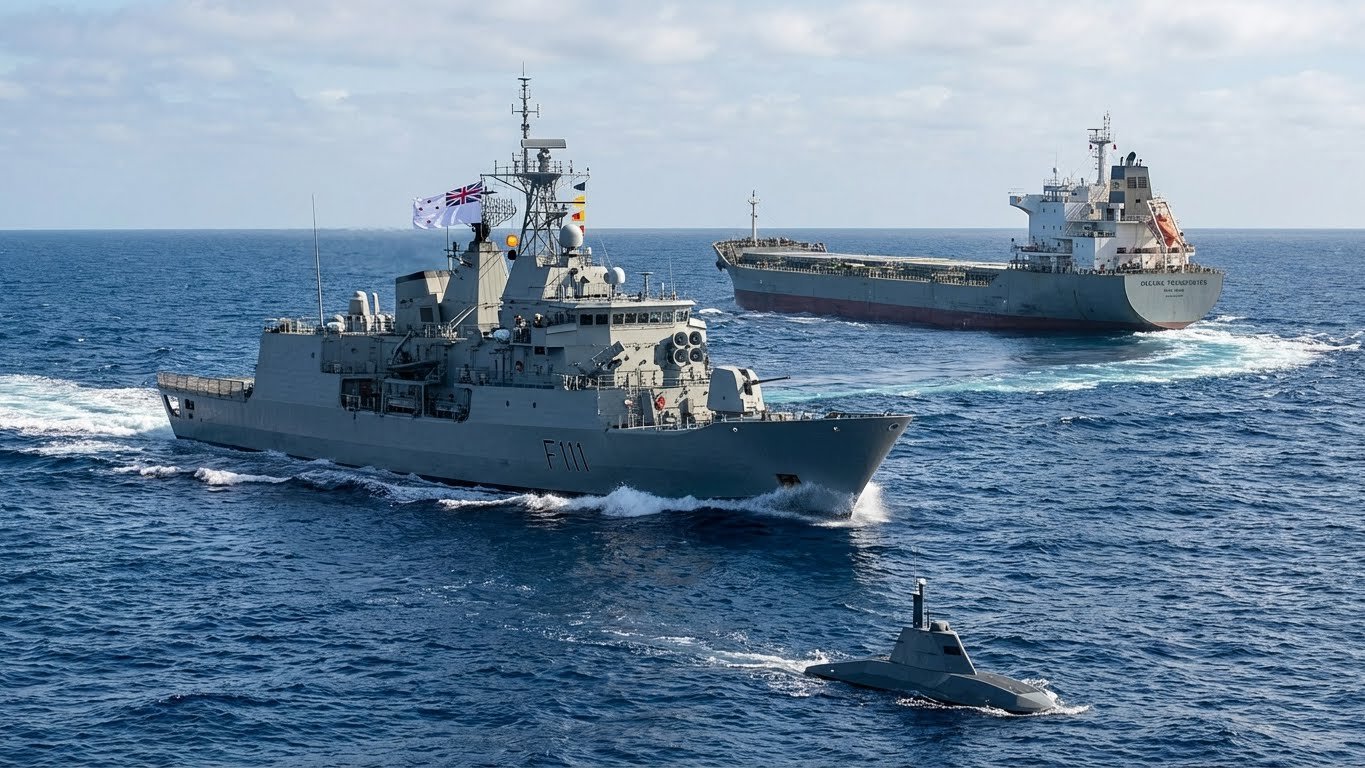
USV — Uncrewed Surface Vessels
Persistent maritime sensing, patrol support, harbour approaches, ship perimeter awareness and distributed ocean monitoring.
UUV — Underwater Systems
Inspection, seabed awareness, underwater survey and monitoring of critical maritime infrastructure without placing personnel into every underwater task.
Extend the fleet’s eyes
Ship-launched uncrewed aircraft can extend observation from naval vessels and support maritime security, search and rescue and Southern Ocean operations.
The operating problem is distance: coastline, EEZ, Pacific responsibilities, Southern Ocean access, ports, sea lanes and underwater connections. Persistence may matter more than platform glamour.
The New Zealand Four-Layer Shield.
The original UAVSHIELD proposed a four-layer island defence model. The 2026 version retains that useful structure but moves away from a narrow “drone strike” model toward surveillance, network resilience, counter-uncrewed defence and critical-infrastructure protection.

Ocean Surveillance
Long-range air, surface, subsurface and space-enabled sensing builds earlier awareness across distant approaches.
Maritime Screen
Distributed sensors and uncrewed platforms extend awareness around sea lanes, naval activity and maritime approaches.
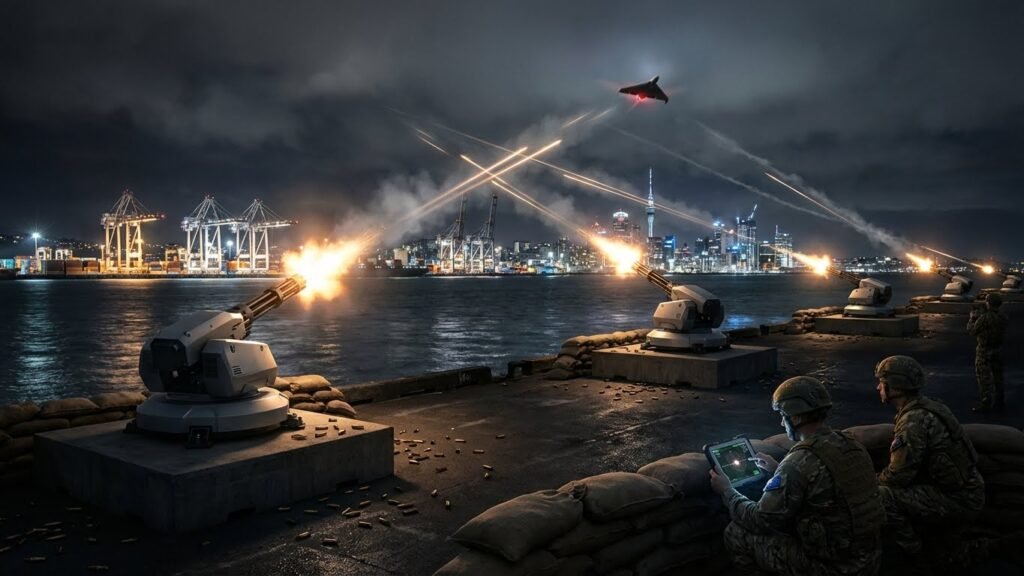
Coastal & Counter-UAS
Mobile sensing, electronic protection and counter-uncrewed capability defend deployed forces, ports and coastal nodes.
Critical Infrastructure
Ports, airfields, energy, communications and key logistics infrastructure require their own local detection and protection layers.
Detection comes before response.
As uncrewed systems become cheaper and more common, New Zealand must be able not only to operate them but also to detect, track, identify and assess hostile or unauthorised systems before any authorised response.
Radar, electro-optical sensors, radio-frequency detection, command systems and authorised protective measures need to work together as one layered defensive network.

Detect ≠ identify ≠ respond. Separating these stages reduces false alarms, improves operator judgement and supports proportionate action.


The real force multiplier is the network.
The machines are only the visible edge. A credible uncrewed force requires sensors, communications, navigation, data fusion, software, electronic protection and human decision-making to operate as one system.


This is the command layer, not an image placeholder. Sensors and machines feed information into a shared picture; software helps organise it, while humans retain responsibility for command and authorised decisions.

Future competition may be increasingly shaped by which side can connect, interpret and act on information more reliably — not simply by which side owns the most individual platforms.
New Zealand does not need to manufacture everything.
Sovereign capability should mean that New Zealand can keep critical systems useful when overseas supply chains slow, software changes, components fail or wartime demand rises.


Develop local capability
Defence policy now explicitly favours opportunities where development, production and sustainment can be delivered within New Zealand.
Focus on the integration layer
Sensors, payloads, command systems, software, data fusion, repair and adaptation may provide realistic areas where a smaller New Zealand industry can contribute strongly.
Partner where scale matters
Proven allied platforms can fill urgent capability gaps while domestic industry builds competence around integration, sustainment and selected sovereign technologies.
The objective is not simply to buy the cheapest drone. It is to avoid using scarce, high-value people and platforms for every sensing, logistics or protection task where a lower-cost, replaceable machine could perform the job effectively.
Separate what exists from what is proposed.
UAVSHIELD uses status labels deliberately. An official plan, market-research activity and an operational capability are not the same thing.
Limited uncrewed systems
NZDF operates limited aerial, surface and subsurface uncrewed systems, primarily in intelligence, surveillance and reconnaissance roles.
Robotic ground vehicles
Public Defence material describes active experimentation with robotic ground vehicles and one-way effector technologies.
Counter-UAS
The 2025 Defence Capability Plan identifies deployable counter-UAS capability with an indicative cost of up to NZ$50 million.
Long-range remotely piloted aircraft
The DCP identifies long-range remotely piloted aircraft for persistent ISR with an indicative investment range of NZ$100–300 million.
Persistent maritime surveillance
The July 2026 RFI seeks information on an unarmed UAS capable of operating up to 1,400 nautical miles from base and remaining on mission for at least six hours.
Polar-capable systems
Defence is examining ship-launched UAS for maritime-domain awareness from the Southern Ocean north toward the equator.
Primary government sources.
Capability figures and programme-status statements on this page are based primarily on published New Zealand Government and Ministry of Defence material.
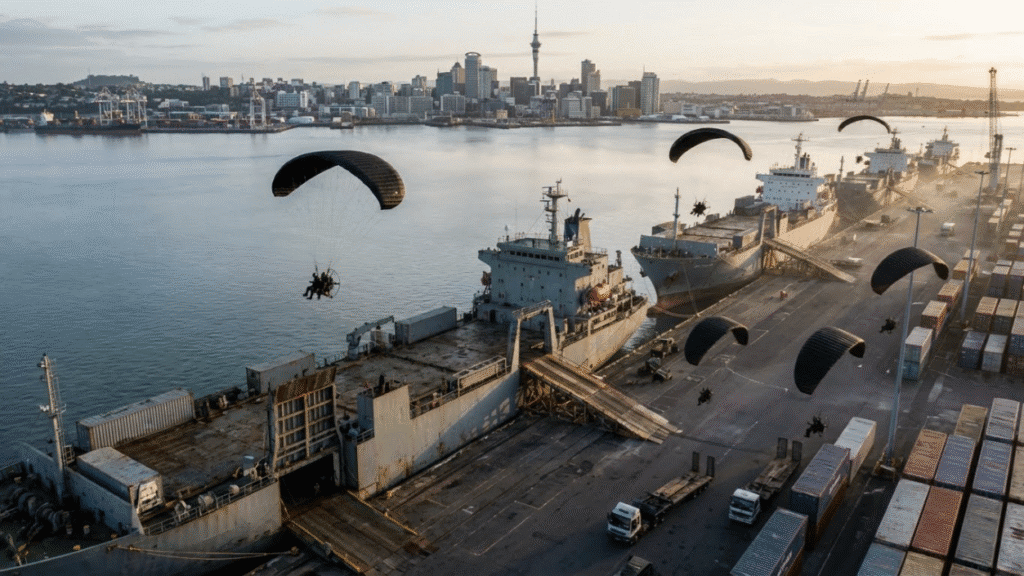
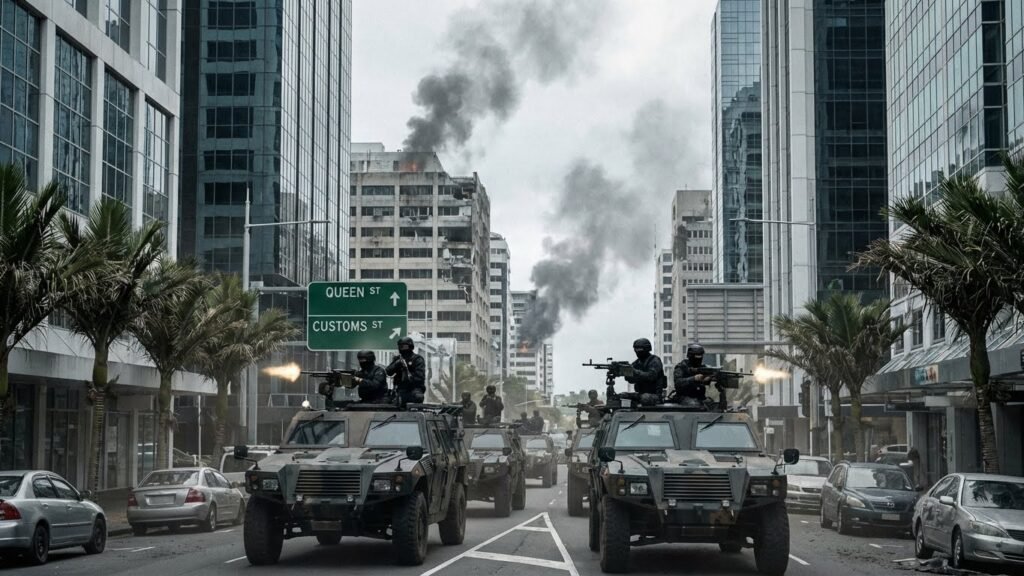
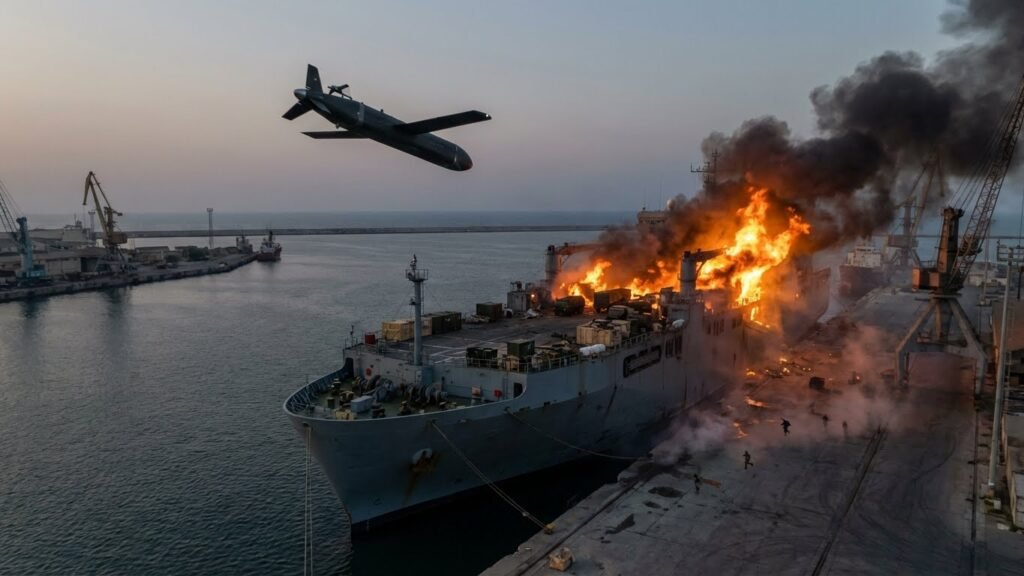
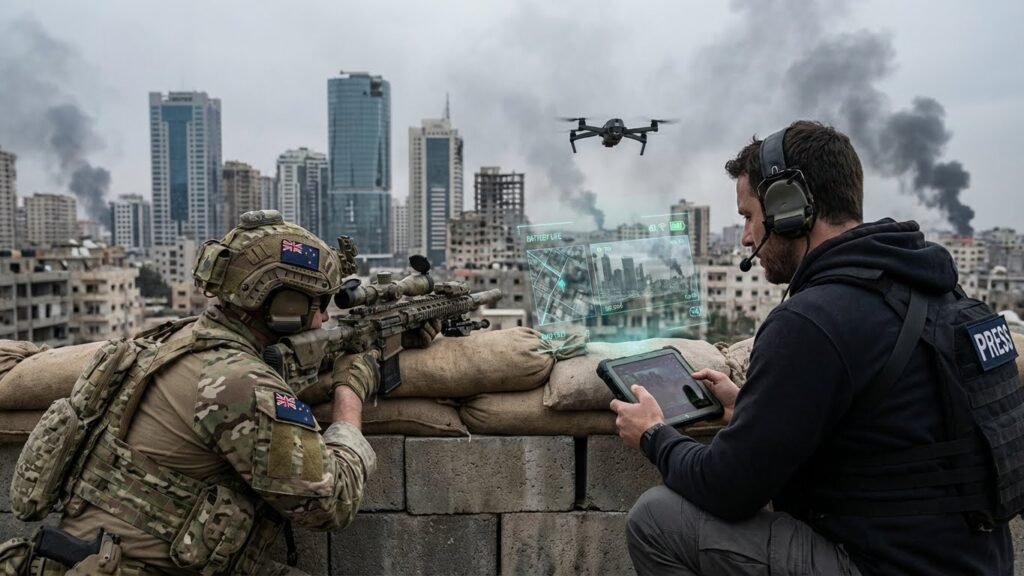
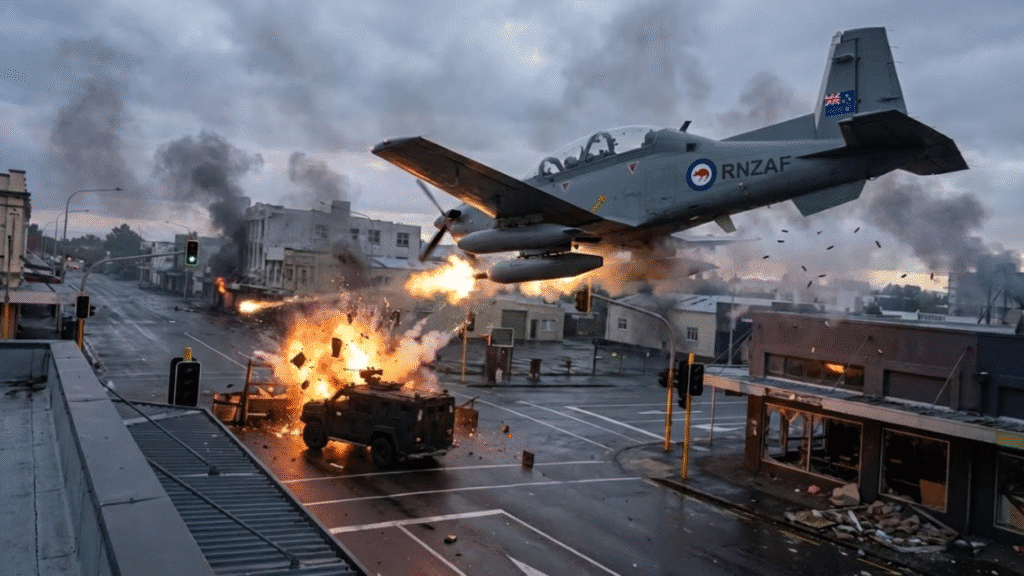
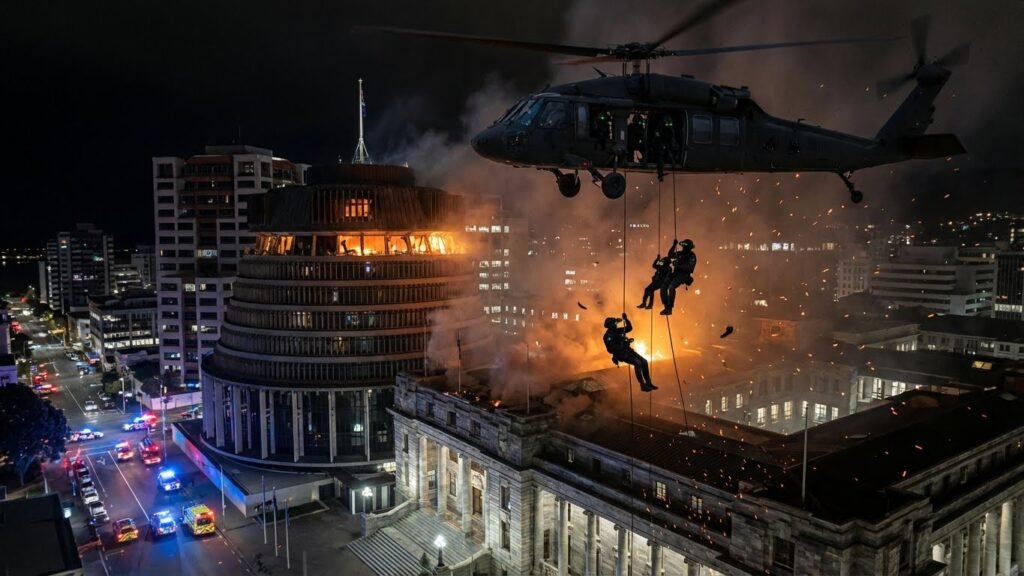
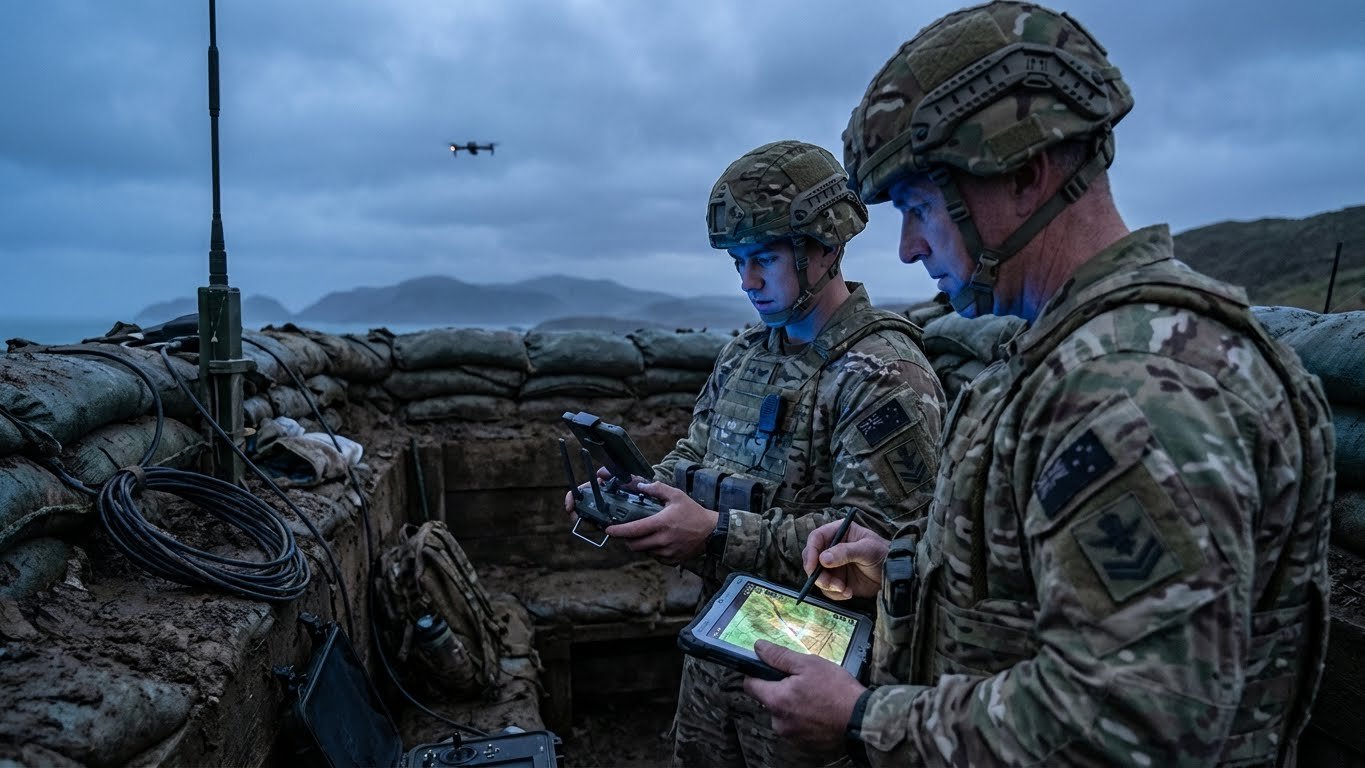
Editorial note: Concept illustrations on this page are used to explain future operating concepts. They should not be interpreted as photographs of current NZDF equipment. “NZWAR Assessment” identifies independent analysis rather than an announced Government policy or funded capability.
New Zealand should not copy somebody else’s battlefield.
It should build an uncrewed system suited to its own geography: maritime, dispersed, resilient, networked, repairable and designed to make limited people and expensive crewed platforms go further.
DEFENCE RESEARCH
NEW ZEALAND