
Something happened. The clock is running.
WARROOM is an event-driven stress test of how New Zealand could face four different states of coercion and war — and how the national response must change with them.
Conflict is not defined by the weapon.
Cyber operations, drones, blockades, economic pressure and armed force are means. WARROOM separates four strategic conditions by what the adversary is trying to achieve and how much New Zealand’s consent still matters.
EXTORT
Threat-backed bargaining. The adversary still needs New Zealand to say yes.
SILENT WAR
A cumulative cross-domain campaign seeks to weaken or bend New Zealand without a clear declaration.
FIGHT & BARGAIN
Force is already in use while political demands and negotiation remain open.
FULL-SCALE WAR
The adversary no longer depends on New Zealand’s agreement and seeks control through force.

EXTORT — Threat-backed bargaining
WARROOM DECISION
The clock is running. Which decisions must be made immediately to protect life, and which political decisions should deliberately not be made under the coercer’s deadline?
Hostage coercion has a political logic
The 1980 Iranian Embassy siege in London and the 1972 Munich Olympics show how hostage-taking can be used to force political attention and concessions, and how quickly a bargaining crisis can become a lethal emergency.
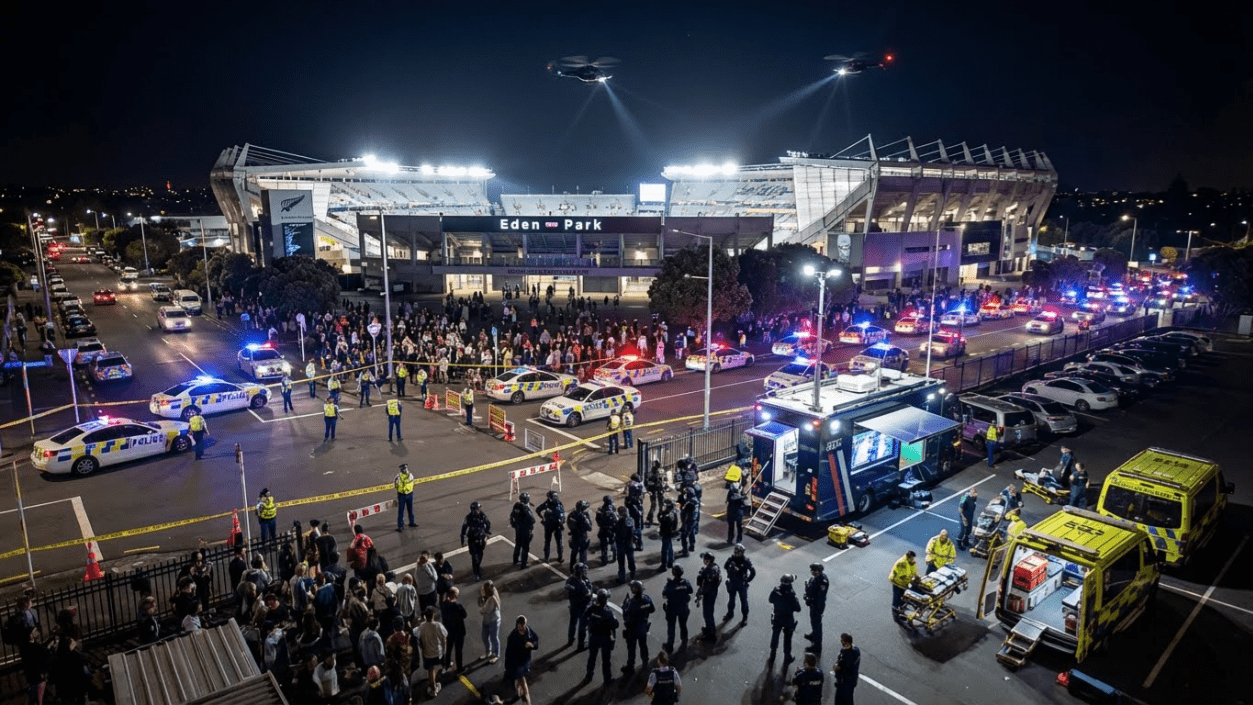
Auckland: a major public event becomes leverage
Hostages are held at a major Auckland event. Political or financial demands are issued with a deadline. The perpetrators seek not only leverage over government but a global media stage.
Negotiation is a tool, not surrender. The governing principles are protection of life, preservation of national political autonomy and denial of automatic reward for coercion.
Pre-authorise the first minutes
WARROOM proposes pre-legislated emergency authority for targeted public-network isolation at a mass-casualty, hostage or severe terror-coercion site. The purpose is to deny automatic livestream reach while preserving secure Police, Fire, medical, government and public-warning communications.
Level 1 local facilitation
A domestic collaborator may appear as a liaison, financier, propagandist, political pressure channel or even an apparent “mediator”. The key question is behavioural: mediator or facilitator?
After the crisis, the investigation must include foreign direction, funding, communications and local support networks.
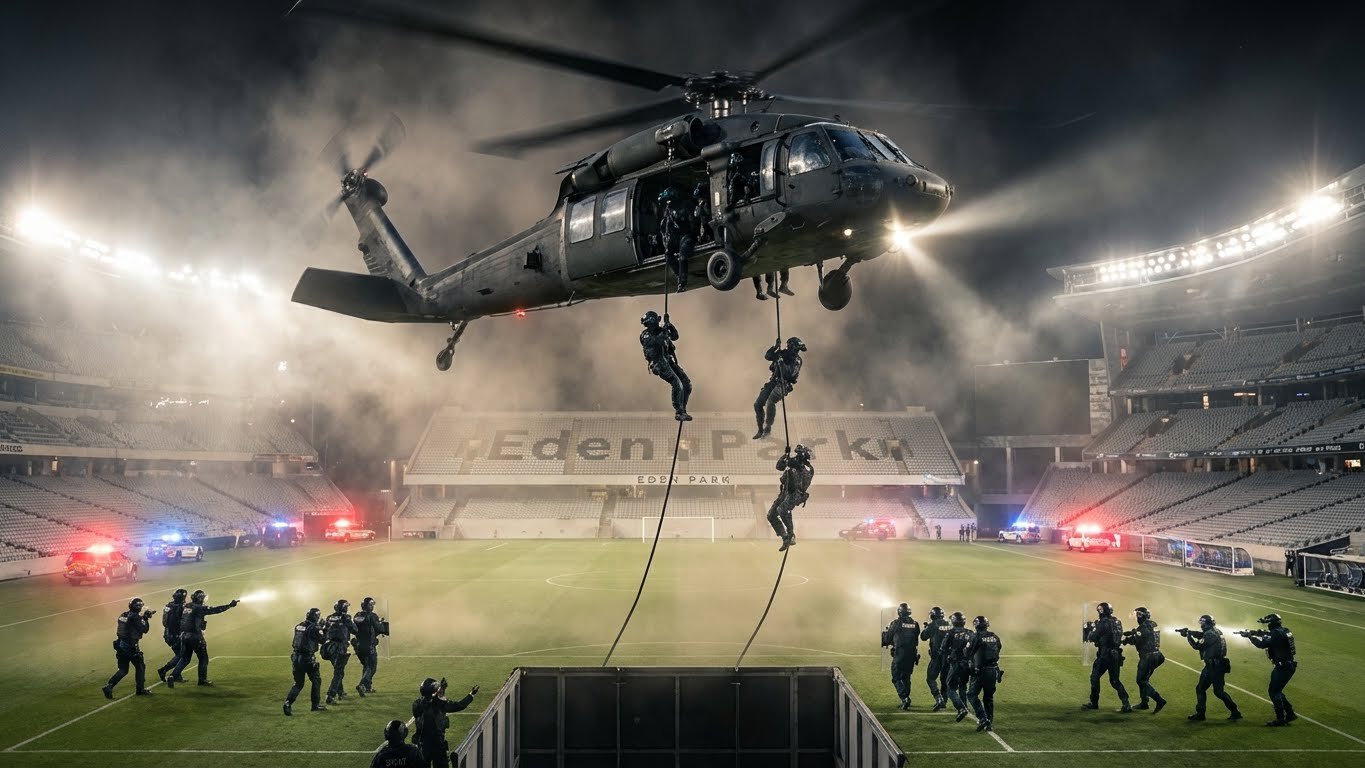
Protect as many hostages and civilians as possible; preserve national political autonomy; deny the attackers the expected political and propaganda reward; terminate the crisis; identify the external and local support network.
SILENT WAR — The war nobody declared
Long-duration coercion can outlive governments
The distinction matters: the 1962 U.S. naval quarantine of Cuba lasted from October to November 1962, while the broader U.S. economic embargo has persisted for more than six decades. The lesson is not that pressure always works; it is that coercion can become a long-duration strategic condition without a clean end date.
Machines find the pattern. Humans decide what it means.
WARROOM proposes a small permanent military-led strategic fusion cell rather than another large bureaucracy. AI continuously gathers, filters and correlates information from GCSB, Police, NZSIS, NZDF, NEMA, critical-infrastructure operators, finance, ports, shipping, fuel, trade, diplomacy and open sources.
Its first responsibility is warning: give government the earliest credible assessment that apparently separate anomalies may in fact constitute an unrestricted-warfare campaign against New Zealand.
Human military analysts remain responsible for source reliability, strategic interpretation, escalation judgement and recommendations to lawful national decision-makers.
COLLECT
Continuously ingest security, economic, diplomatic, infrastructure and open-source signals.
CORRELATE
Link events across agencies and sectors that would otherwise remain separate files.
ANOMALY DETECTION
Identify timing, geography, funding or system behaviour that departs from the normal baseline.
PATTERN RECOGNITION
Test whether many small incidents form one coordinated strategic campaign.
HUMAN JUDGEMENT
Military analysts decide what the pattern may mean and when government must be warned.
Detect → Decide → Defend → Repair → Counter
New Zealand cannot physically protect every cable, substation, payment node, port asset and transport link. Resilient operation and fast restoration are therefore part of defence, not merely post-crisis recovery.
Capability without political will is only inventory. A silent campaign must not be allowed to continue simply because each individual incident can be explained away. If collective deterrence changes the cost equation, the campaign may stop; if it does not, deeper alliance integration and political negotiation become later instruments, not the first response.
A small state can still reach a distant adversary.
North Korea offers a different strategic lesson. Despite its limited economic base, it has concentrated national effort on selected cyber, intelligence, electronic and other strategic capabilities that can create effects far beyond the country’s physical size.
The lesson for New Zealand is not to copy North Korea’s political system, doctrine or behaviour. It is that national size does not automatically determine strategic reach. A small state that concentrates political will, technology, intelligence, specialist skills and sustained investment on selected capabilities can still influence the calculations of a much larger and more distant power.
New Zealand does not need symmetrical strength. It needs credible options that make hostile coercion costly, uncertain and strategically unattractive. Distance should not mean that an adversary can pressure New Zealand while assuming that New Zealand has no meaningful means of response.


Level 2 covert enabling
Foreign-linked facilitation may shift into covert intelligence support, internal access, concealed finance, network assistance, information manipulation or sabotage support.
The trigger for heightened security attention is conduct and covert coordination, not ethnicity, religion, ancestry or lawful political opinion.
FIGHT & BARGAIN — Force is already in use
Modern coercive wars attack endurance as well as forces.
Recent conflicts have repeatedly shown that shipping risk, ports, energy, insurance, supply chains and civilian confidence can become part of the strategic contest. For New Zealand, the relevant lesson is not to copy another battlefield, but to treat maritime access and national sustainment as part of deterrence.
WARROOM DECISION
When military pressure is already affecting trade and supply, what must be protected first so that negotiations remain political choices rather than decisions forced by an empty tank?

The Maritime Lifeline
Shipping, marine insurance, fuel and critical imports are under sustained military pressure. Australia may be simultaneously drawn into the regional conflict. The objective of coercion is to make New Zealand accept political or strategic terms before the country can adapt.
Response: endure, fight, counter, bargain.
First make the numbers understandable
kt means thousand tonnes. To keep the figures easy to read, WARROOM presents fuel requirements as approximate mass only.
Current statutory minimum cover — illustrative physical equivalent using the WARROOM daily-demand baseline
| Fuel | Minimum cover | Approx. mass |
|---|---|---|
| Petrol | 28 days | ≈169 kt |
| Diesel | 21 days | ≈189 kt |
| Jet fuel | 24 days | ≈92 kt |
The legal obligation is expressed as days of cover and calculated from rolling demand. The mass figures are an illustrative WARROOM conversion for public understanding, not the legal formula itself.
NZWAR critical-demand planning model — 25% of normal national demand
| Fuel | 90 days | 180 days | 365 days |
|---|---|---|---|
| Petrol | ≈136 kt | ≈272 kt | ≈551 kt |
| Diesel | ≈202 kt | ≈404 kt | ≈820 kt |
| Jet fuel | ≈86 kt | ≈173 kt | ≈350 kt |
| Combined total | ≈424 kt | ≈849 kt | ≈1,721 kt |
Illustrative NZWAR model only. “25% critical demand” is not an official government target. It is a planning scenario for essential sectors such as defence, emergency services, food logistics, electricity backup, ports, agriculture, critical industry and necessary aviation.

Do not reduce the question to “rebuild the old refinery”.
The strategic question is the minimum domestic capability New Zealand should retain for fuel processing, conversion, storage and emergency distribution if imported refined fuel is severely disrupted.
WARROOM also treats empty surge storage as strategic capacity: dispersed tanks or other validated storage options can be filled before or during escalation rather than permanently held full in peacetime.
Do not mobilise what the war does not yet require.
Level 3 activates the skills that are actually needed — maritime crews, logistics, heavy-vehicle drivers, engineers, medical staff, uncrewed-system operators and repair teams — while keeping the wider economy functioning.
The adversary may want New Zealand to bleed itself economically. Selective mobilisation denies that objective.

Level 3 wartime collaboration
Once domestic facilitation crosses from speech, association or propaganda into actual wartime support — intelligence, logistics, sabotage assistance or direct support to hostile operations — it becomes a wartime security problem. Response must focus on verified hostile conduct, not identity or belief.
Keep the maritime lifeline functioning, preserve critical fuel and essential services, impose enough counter-pressure to prevent one-sided coercion, and retain the ability of elected government to negotiate without being forced by immediate national collapse.
First prove that coercion cannot rapidly break New Zealand. Only then does bargaining preserve genuine choice. Counter-pressure begins in this chapter, including lawful action against military logistics, military command-and-control and other lawful military objectives.
FULL-SCALE WAR — National survival and restoration
An integrated Anzac force is now an explicit policy direction.
The March 2026 Anzac 2035 statement sets a goal for Australian and New Zealand forces to operate increasingly seamlessly as an integrated, combat-capable Anzac force by 2035. It identifies combined operations, force posture, preparedness, resilience, defence-industry integration and shared sustainment as practical lines of effort.
WARROOM therefore treats Australia as part of the strategic operating environment from the beginning of a major conflict — while preserving the fact that Australia and New Zealand remain separate sovereign states.
WARROOM DECISION
If several national systems fail at once, which functions must never lose legitimate command: government, public warning, defence, power, communications, health, logistics and allied coordination?

Continuity of legitimate elected government
Government must not merely survive physically. It must continue to issue lawful orders, communicate with the public and allies, maintain national command and demonstrate visibly that the state is still functioning.
WARROOM does not model capitulation scenarios. Decisions on surrender, ceasefire or political settlement belong to elected government; this analysis focuses on continuity, resistance, civilian survival and restoration of sovereign control.

The government must still be able to talk when one network fails.
National continuity requires more than a public app. Critical government, emergency and defence communications should retain multiple independent paths so that failure of one network does not isolate national command.
Principle: the NZ Wartime App is a civilian interface. It sits on top of a deeper redundant communications architecture; it does not replace it.

ANZAC interoperability must extend to civilians.
The wartime civil-support platform should reserve standardised APIs for an Australian counterpart so alerts, evacuation, shelter, medical assistance, volunteer coordination and infrastructure status remain interoperable across the joint theatre.

Build the legal and organisational structure in peacetime.
Priority layers: former service personnel; specialist technical reservists; then volunteer citizens who have passed security vetting, training and organised unit assignment.
The policy question is not improvised wartime distribution. It is whether New Zealand should legislate a controlled, trained, periodically reviewed and command-linked reserve structure before crisis.
Train first. Vet first. Organise first. Arm only through command structure.
Right skill, right unit, right place.
Drone operators, robotics personnel, software and cyber specialists, electronic engineers, communications staff, aviation personnel, maintenance technicians, medical professionals and heavy-vehicle drivers enter specialist wartime structures.
Local people + local equipment + national command. Distributed secure reserve nodes reduce the vulnerability and delay created by long-distance concentration.


National mobilisation does not mean abandoning national function.
Evacuation is organised by risk area and civilian vulnerability while hospitals, power, communications, logistics, government, public safety and other critical functions remain staffed.
Visible functioning institutions and organised friendly capability are themselves sources of public order and confidence.
The wrong temperament in the wrong wartime role can cost lives.
Wartime assignment should consider judgement, pressure tolerance, discipline, empathy and resistance to manipulation as well as technical skill. Strong care-oriented personnel may be particularly valuable in medicine, shelters and family support; counter-intelligence and hostile-person screening require different psychological strengths and strict procedural discipline.
Preserve constitutional government and national command; keep civilians and essential systems functioning; integrate allied support; deny durable hostile control; and retain the organised capacity to restore full sovereign authority.
Australia and New Zealand may both be under attack; allied combat power is therefore part of the theatre from the start, not an external rescue force that appears later.

Four states. Four responses. One requirement: remain governable.


Readiness is not militarising society. It is making society harder to break.
Government, defence, critical infrastructure, professional communities, civilian support systems and allies should be connected before the crisis begins.
WARROOM is therefore not a prediction. It is a way to ask whether New Zealand can still govern, communicate, supply, repair, protect and respond when the character of coercion changes.
The 2026 test
New Zealand’s official assessments now describe a deteriorating security environment, persistent state-linked cyber activity, foreign interference and espionage, while Defence policy is moving toward greater combat capability, resilience, uncrewed systems and deeper Anzac integration. The question is no longer whether resilience belongs in national security. It is whether the institutions, reserves, industry and public systems are connected before pressure arrives.