Uavshield
LESSONS FROM UKRAINE
From the “Drone Wall” to “Algorithmic Warfare”: A military revolution driven by low-cost tech, software definition, and mass mobilization.
1. Frontline Revolution: The Uavshield “Drone Wall”
Tactical Concept
A high-density “defense/kill barrier” established within 10km of the frontline using swarms of tactical attack drones and loitering munitions. Enemy vehicles and personnel are destroyed immediately upon exposure.
Organizational Change
- • Crowdfunding: “Army of Drones” initiative.
- • Decentralization: Drones issued to company-level units.
- • Equipment Ratio: Up to 60% of gear in assault brigades are drones.
- • FPV Companies: Specialized units dedicated to suicide drone ops.
2. Rear Strategy: Deep Strike & Asymmetric Cost
14th Unmanned Aviation Regiment
Commanded by “Kasper”, equipped with dedicated analysts and engineers for long-range precision strikes.
3. Tech Evolution: Software & AI
📱 Digital Command Integration (GIS Arta / Delta)
Fiber-Optic Drones
Physically connected via kilometers of fiber cable.
- ✓ 100% Jam-Proof (EW Immune)
- ✓ Crystal Clear Video Feed
- ✗ Range Limited (10-20km)
Sky Sentinel AI Turret
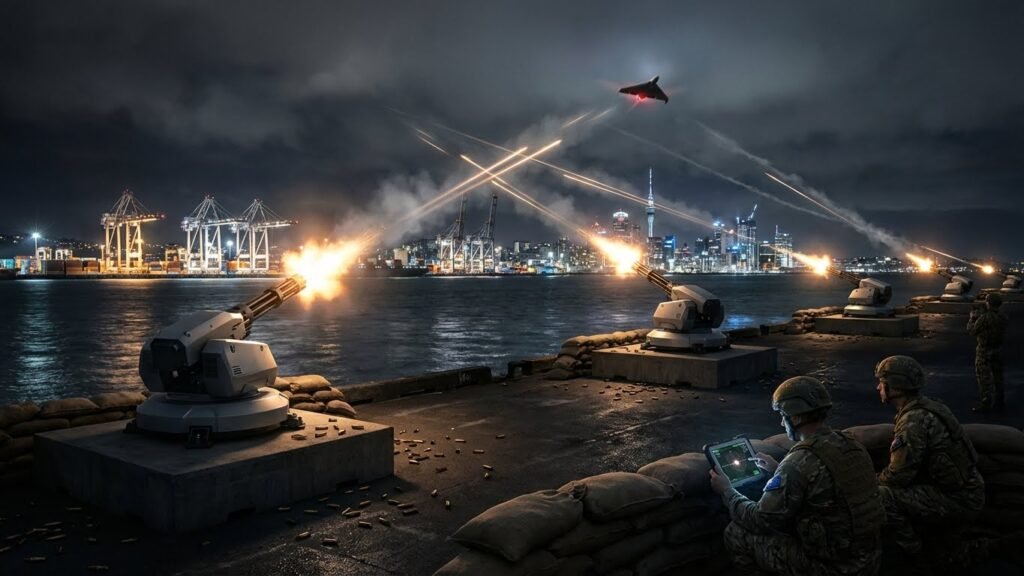
Fully automated heavy machine gun turret with AI acoustic/visual detection.
- • Cost: $150k (vs Millions for Patriot)
- • Target: Shahed Suicide Drones
- ✓ 24/7 Fatigue Free
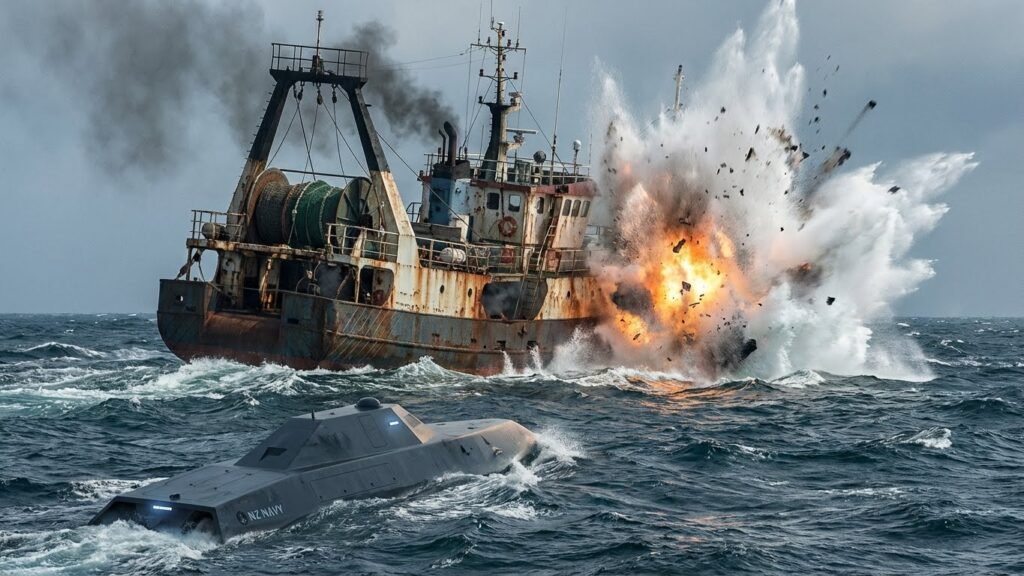
Kamikaze Sea Drones (USV)
Low-cost explosive speedboats attacking naval vessels.
- • Result: ~20 RU ships hit/sunk
- • Impact: Black Sea Fleet forced to retreat
- ✓ Small beats Large
Op Cobweb (AI Swarm)
June 2025 Case Study with terminal AI guidance.
- • Role: Split between suppression & attack
- • Tech: Autonomous lock-on after signal loss
- ✓ Fire and Forget
4. Statistics & Forecast
Russian Equipment Loss Attribution
Source: West Point CTC / Hudson Institute Estimates
UA Drone Production Forecast (Annual)
Chapter Summary
The war in Ukraine has proven the viability of “Unmanned” and “Mass-Mobilized” warfare. Drones have evolved from auxiliary tools to the primary battlefield killers (causing ~70% of losses). The future battlefield will be a high-speed race between “Spear and Shield”: Fiber-optic anti-jamming, AI autonomous attacks, and swarm coordination will become the new normal, fundamentally altering the nature of ground and naval combat.
Global Systems Comparison
Analyzing the strategic gap between New Zealand’s current capabilities and the drone-centric warfare of major global powers.
1. New Zealand (NZDF) Focus
Current Status: ISR & Non-Combat Support
Strategic Stance: “The Eyes, Not The Fists”
New Zealand currently utilizes unmanned systems exclusively for Intelligence, Surveillance, and Reconnaissance (ISR). Unlike Ukraine or major powers, NZDF drones are unarmed tools used for border patrol, disaster relief, and maritime monitoring to supplement expensive manned assets like the P-8A Poseidon. The focus is on situational awareness, not kinetic action.
Broken Kill Chain
Can detect targets but cannot engage. Relies on slow, traditional fire support (artillery/missiles) which may be scarce.
Organizational Void
No independent “Unmanned Systems Corps”. Operators are dispersed within traditional units. Lack of specialized training.
Supply Fragility
100% import dependency. In a naval blockade scenario, drone fleet spare parts would be exhausted rapidly.
Current NZDF Inventory
Fixed-wing VTOL. Used by Artillery Regiments for targeting.
Quad-copter. Used by Infantry for close surveillance.
Pocket-sized. Used for urban/indoor clearing.
Critical offensive capability gap identified.
2. Global Powers: Strategies & Tech
| Nation / Dimension | 🇺🇸 USA (Systemic) | 🇨🇳 China (Supply Chain) | 🇷🇺 Russia (Combat Tested) | 🇪🇺 Europe (Catching Up) |
|---|---|---|---|---|
| Core Strategy | Replicator Initiative: Mass over Quality. Deploying thousands of autonomous systems (ADA2) to counter swarms. |
Civil-Military Fusion: Leveraging DJI supply chain dominance. Developing full-spectrum intelligent swarms. |
Adaptation & EW: Decentralized command. Massive production of Shahed/Lancet. Strong Electronic Warfare. |
Awakening: Realizing air defense gaps. Buying US/Israel tech while accelerating local training. |
| Key Equipment | Switchblade 600 Coyote Interceptors Loyal Wingman |
Wing Loong / Rainbow Modified Commercial Swarm Launchers |
Lancet (Loitering) Shahed-136 Orlan-10 |
Bayraktar TB2 (Turkey) Laser Defense Imported Systems |
| Tech Focus | AI Autonomy + Sat Links | Full Chain + 5G Swarms | Anti-Jamming + Mass Production | Import + Local Innovation |
USA
Acknowledges expensive missiles cannot stop cheap drones. Shifting to cheap, mass-producible autonomous interceptors.
Switchblade, Coyote, AI Turrets.
China
Leverages dominance in commercial components (motors, ESCs). Focuses on “Intelligent Swarm” and saturation attacks.
Wing Loong, Rainbow, Modified DJI.
Russia
Painful transition from centralized to decentralized. Mass production of Shahed (strategic) and Lancet (tactical).
Lancet-3, Shahed-136, Electronic Warfare.
Europe
Shocked by Ukraine war. Moving to close air defense gaps against drones. Heavy reliance on training with Ukraine.
Bayraktar TB2 (Turkey), Laser Defense.
3. Strategic Data Analysis
Ratio of Attack Drones in Inventory (Est.)
New Zealand: 0% — A critical offensive gap compared to global standards.
Supply Chain Autonomy
NZDF relies entirely on imports, creating high vulnerability in wartime blockade scenarios.
NZ STRATEGIC
SIMULATION & ASSESSMENT
A four-layer unmanned defense network tailored for island defense needs, with asymmetric efficiency and cost-benefit analysis compared to traditional forces.
1. Island Defense: Four-Layer Unmanned Shield
Layered defense system combining geographical characteristics
🌊 Layer 1: Ocean Depth Warning
Outer EEZ- • Long-Endurance UAVs: 24/7 patrol forming an aerial electronic fence.
- • Digital Battle Mgmt (Like Delta): Integrating drone, radar, and sonar data for a real-time maritime map.
- • Benefit: “Remote Roll Call” monitoring, replacing expensive limited manned flights, vastly increasing warning range.
🚤 Layer 2: Nearshore Warning & Strike
Coastal Waters- • Suicide USVs: Hidden in harbors, high-speed swarm impacts to deny landing at low cost.
- • Land-based Loitering Munitions: Ultra-low altitude sea-skimming, AI terrain matching, precision strikes through defenses.
- • Benefit: Building an “Invisible Coastal Defense Line”, multi-directional pincer attacks forcing enemy ships to keep distance.
🏖️ Layer 3: Anti-Landing Strike
Beachhead- • FPV Swarms: Dense attacks on landing craft and amphibious vehicles, targeting cockpits and fuel tanks.
- • Fiber-Optic Anti-Jamming: Ensuring precision hits in high-intensity EW environments.
- • Unmanned Remote Fire: Sensors trigger remote MGs/Mortars, suppressing enemies without exposing personnel.
- • Benefit: “3D Kill Zone”, combining mines, FPVs, and artillery to delay and degrade the enemy vanguard.
🛡️ Layer 4: Homeland Critical Defense
Critical Infra/Cities- • AI Auto AA Towers: Sky Sentinel-class systems, 24/7 monitoring, millisecond reaction to intercept incoming drones.
- • Electronic Jamming Net: Protecting power plants and comms towers from sabotage.
- • Police Support: Police drones assisting in border and forest patrols.
- • Benefit: Low-cost, high-efficiency terminal shield ensuring the safety of the national nerve center.
2. Operational Benefit Assessment: Digital & Asymmetric Advantage
Tech-enabled Defense Upgrade
Surveillance Coverage Multiplied
Long-endurance drones combined with Digital Command (Delta) realize a “Detect = Destroy” rapid chain. Lower cost compared to traditional patrols, wider coverage, no blind spots.
Extreme Asymmetric Strike
Deterring multimillion-dollar enemy ships with drones/USVs costing tens of thousands. Hidden standby, random engagement, forcing the enemy to widen perimeters, effectively degrading their combat power and morale.
Autonomous Ops & Resilience
With AI assistance, systems possess millisecond reaction and offline autonomous attack capabilities. Even if the command chain is damaged, dispersed unmanned systems continue to operate, offering high defense resilience.
3. Personnel Training & Logistics
Mass Mobilization & Supply Chain Resilience
Talent Reserve: Militarizing the Gaming Generation
Pilot Scouting & Competition
Targeting eSports and FPV players, hosting national challenges, building a reserve pilot database. Rapid expansion in wartime, ensuring “More Pilots than Drones”.
Youth STEM Education
Establishing drone clubs in schools, combining defense needs with tech education. Cultivating future tech specialists and reserve officers.
Systematic Military Training
Establishing formal drone curriculums covering repair, tactical coordination, and anti-EW. Enhancing professional standards for active and reserve forces.
Logistics: Decentralized Production & Reserve
Strategic Parts Reserve
Peace-time stockpiling of motors, batteries, chips. Countering wartime import blockade risks.
3D Printing & Rapid Prototyping
Establishing defense 3D printing centers, integrating civilian equipment. Mobilizing mass production in wartime for Self-Sufficiency.
Frontline Repair & Feedback
Forming field repair teams for rapid restoration. Establishing rapid feedback mechanisms to iterate gear based on battlefield needs.
4. Effectiveness & Cost-Benefit Comparison
Unmanned Systems vs Traditional Gear
Anti-Armor: Missile vs FPV
Javelin missiles cost $300k-400k each, FPV drones only $500. Kill-cost ratio reaches 1:1000. FPVs also allow multi-angle saturation attacks.
Long Range Strike: Cruise Missile vs Suicide Drone
Long-range suicide drones cost only 1/10th of missiles yet achieve similar strategic effects, with the flexibility to abort mid-flight.
Ops Maintenance: Manned vs Unmanned
P-8A flight costs tens of thousands per hour; drones cost hundreds. Long-term operational costs are drastically reduced.
Conclusion: With limited budget, investing in unmanned systems yields maximum defense benefit, overwhelming expensive enemy offenses with cheap smart gear.
Strategic Conclusion: Victory Belongs to a Prepared New Zealand
New Zealand must act swiftly to formulate a drone defense strategy, establish dedicated units, and build civil-military fusion mechanisms for rapid procurement and talent cultivation.
By prioritizing “Cheap & Mass” asymmetric equipment (like FPV swarms, USVs) combined with advanced digital battle management, New Zealand can construct a 3D defense network of “Remote Monitor + Coastal Strike + Homeland Air Defense”. This agile, efficient “Decentralized Swarm” force will be key for New Zealand to maintain national security and stand invincible in future geopolitics.