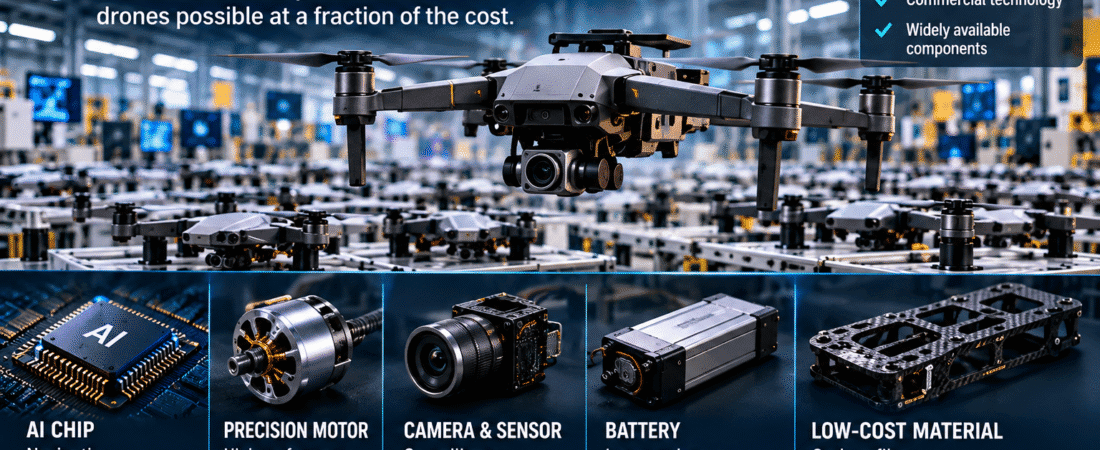
Consumer electronics in modern warfare are reshaping how military equipment is designed, manufactured and deployed.
Subtitle: From drones overwhelming legacy air defences to unmanned vehicles, vessels and aircraft challenging traditional military systems
Modern warfare is undergoing a fundamental transformation.
This transformation is not simply the emergence of another weapon, nor is it a matter of cheap weapons occasionally defeating expensive ones. It reflects a new stage of industrial development in which modern economies can manufacture intelligent unmanned military systems at scale.
Materials science, precision engineering, electronic chips, artificial intelligence, satellite navigation, aerodynamics and automated manufacturing are converging to create a new generation of military products.
Drones are the first major example of this transformation to appear on battlefields in large numbers.
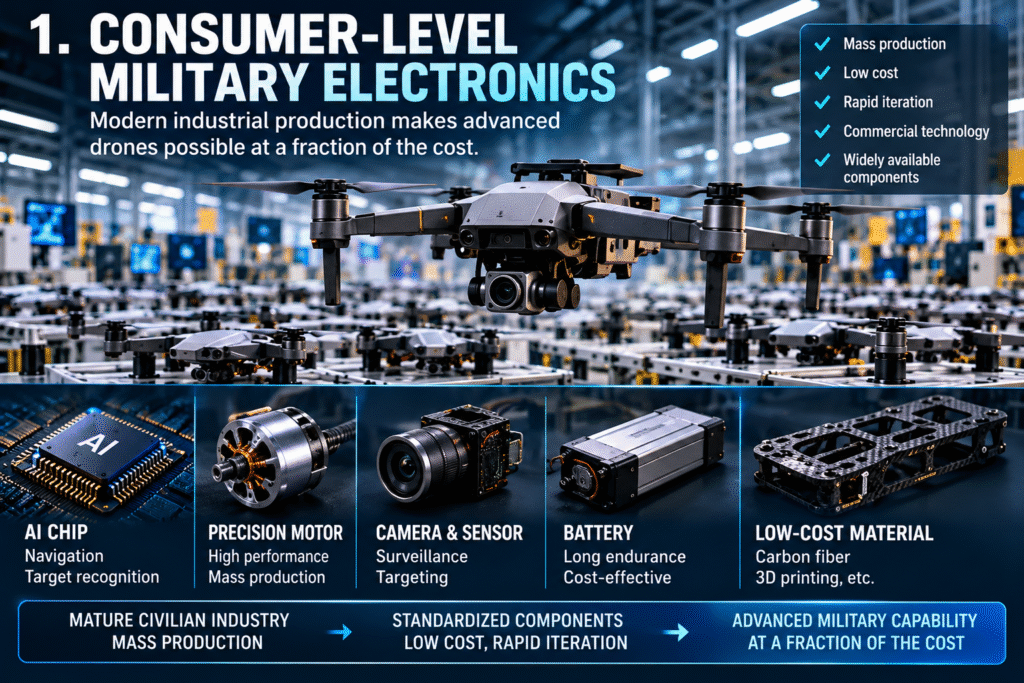
Their relatively low cost does not indicate technological backwardness. On the contrary, their affordability reflects mature industrial technologies, standardized components and mass production.
Drones are not merely cheap weapons for poor countries. They are consumer-grade military electronic products made possible by modern industrial productivity.
More importantly, this manufacturing model will not remain limited to aerial drones.
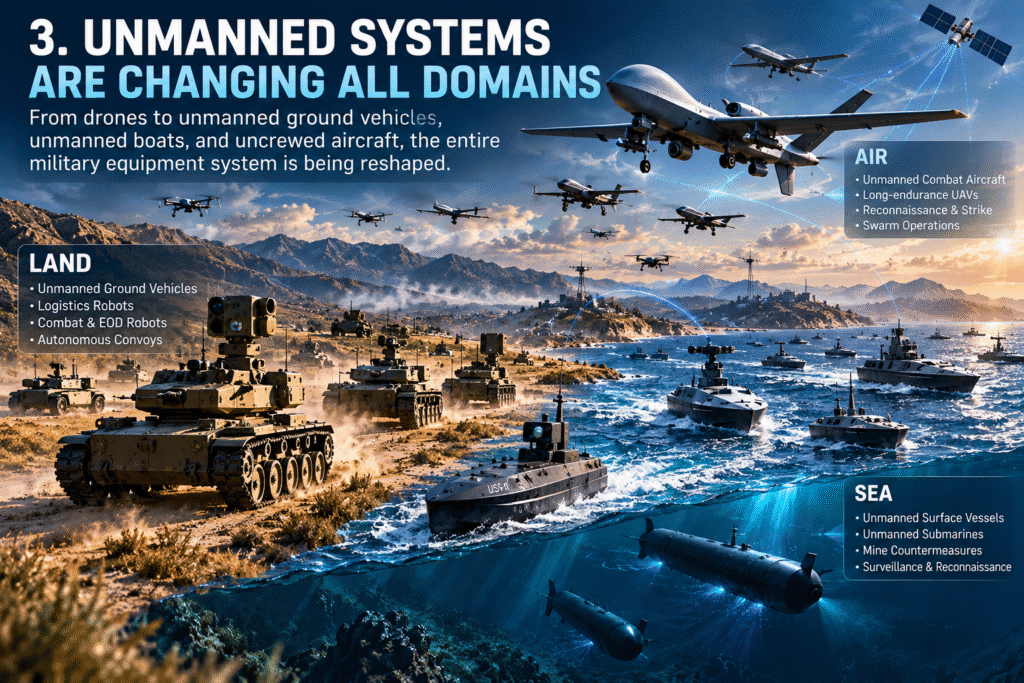
Unmanned ground vehicles, robotic combat vehicles, unmanned surface vessels, underwater systems and unmanned combat aircraft are developing along similar technological lines.
Military functions that once required direct human operation are gradually being transferred to software, sensors, automated control systems and artificial intelligence.
Modern military equipment is entering a new generational transition.
1. The Low Cost of Drones Reflects Advanced Productivity, Not Primitive Technology
Traditional military equipment has often depended on highly specialized defence industries.
Development cycles are long, production lines are purpose-built, components are complex, and manufacturing volumes are constrained by cost, procurement requirements and industrial capacity.
Modern small drones operate on a different industrial foundation.
Many of their essential technologies are already widely available in civilian manufacturing.
High-performance processors, miniature sensors, imaging systems, wireless communication modules, batteries, electric motors and composite materials are all supported by mature commercial supply chains.
CNC precision machining, plastic and metal 3D printing, automated assembly and software-based control further reduce manufacturing barriers for many components.
None of these technologies is inherently simple. They represent decades of accumulated industrial development.
A drone may contain sophisticated flight-control systems, navigation software, image processing and automatic stabilization, yet many of its components can still be manufactured in large quantities through established industrial processes.
Low cost does not mean low technology. It means advanced technology has become standardized, commercialized and scalable.
In this sense, many drones increasingly follow the production logic of modern consumer electronics rather than the traditional model of expensive military equipment manufactured in relatively limited quantities.
2. Consumer-Grade Military Electronics Are Blurring the Boundary Between Civilian and Defence Manufacturing
A useful description of this new category is:
Consumer-grade military electronic products.
This term describes their industrial foundation, not their destructive potential.
A drone carrying a camera can be used for photography, mapping or recreation.
Equipped with military surveillance equipment, it can perform battlefield reconnaissance.
Carrying an explosive payload, it becomes part of a weapon system.
The mission and payload change, but the underlying manufacturing technologies may come from similar industrial ecosystems.
This is one of the major differences between modern drones and many traditional military platforms.
Modern economies already possess enormous networks of electronics manufacturers, machining companies, software developers and component suppliers.
These industrial capabilities can support the production and continuous improvement of large numbers of unmanned platforms.
Reliable military drones still require solutions to electronic interference, environmental stress, quality assurance and system integration. Commercial components do not automatically produce battlefield-ready equipment.
Nevertheless, an important shift is underway.
The ability to manufacture certain military systems is expanding beyond traditional defence contractors into the broader advanced industrial economy.
Military manufacturing barriers are changing.
A country’s military-industrial potential can no longer be measured solely by the number of conventional weapons factories it possesses.
Its electronics industry, software capabilities, precision manufacturing and automated production capacity are increasingly important.
3. Drones Are Overwhelming the Design Logic of Legacy Frontline Air Defence
Earlier generations of frontline air-defence systems were designed primarily around aircraft, helicopters and particular categories of airborne threats.
These systems can detect, track and engage aerial targets, but their deployment methods, ammunition stocks, sensors and engagement procedures were often developed around a relatively limited number of targets.
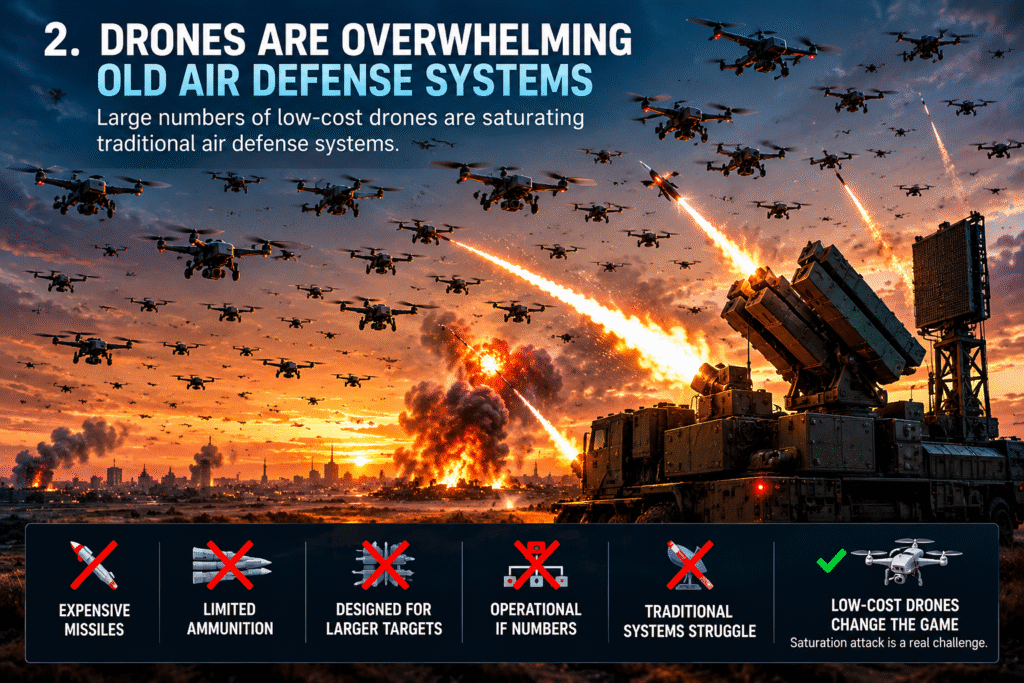
The mass deployment of small drones has changed that environment.
Battlefields now contain far more airborne objects with different sizes, speeds, flight profiles and operational roles.
Traditional air-defence systems are not necessarily incapable of shooting down drones.
The challenge is that a constant flow of small targets creates demands for detection, identification, tracking and interception at a frequency that older systems were not always designed to sustain.
A system highly effective against conventional aircraft may not be economically or operationally suited to handling large numbers of small drones over extended periods.
Expensive surface-to-air missiles are not necessarily the most appropriate response to every such threat.
As a result, armed forces are developing and employing a range of counter-drone technologies, including electronic warfare, automated gun systems, programmable airburst ammunition, directed-energy weapons and short-range interceptors.
Among these, machine guns and automatic cannons supported by AI-assisted detection and fire control deserve particular attention.
Such systems may be able to combine established mechanical engineering, sensors and computing technology to achieve relatively low interception costs while operating alongside mobile ground forces.
Their effectiveness nevertheless depends on accurate identification, fields of fire, ammunition availability, environmental conditions and engagement safety.
Future frontline air defence is therefore more likely to involve multiple complementary technologies than one universal counter-drone weapon.
What drones are making obsolete is not air defence itself, but the design assumptions behind an earlier generation of battlefield air-defence systems.
4. From Tanks to Warships, Traditional Manned Platforms Face the Same Challenge
The impact of drones extends well beyond air defence.
On land, tanks, armoured vehicles, artillery positions and logistics vehicles increasingly face persistent aerial surveillance and attack threats.
Traditionally, the survivability of an armoured vehicle depended heavily on armour protection, mobility, firepower and tactical coordination.
Today, it must also contend with the possibility of being continuously observed and attacked by numerous unmanned platforms.
This does not mean tanks have become useless.
It means the conditions under which traditional armoured equipment can survive and operate effectively are changing.
A similar transformation is occurring at sea.
Unmanned surface vessels can undertake reconnaissance, patrol and certain attack missions, creating new threats to conventional manned ships.
Large warships still offer capabilities in long-range operations, integrated air defence, command and control, and multi-mission warfare that small unmanned vessels cannot simply reproduce.
Nevertheless, navies must reconsider how expensive manned platforms can operate safely against more numerous, flexible and potentially less costly unmanned systems.
Unmanned systems are forcing traditional manned military platforms to demonstrate their operational value under new conditions.
The value of a military platform can no longer be assessed only through firepower, armour thickness, speed or radar performance.
Its survivability, operational effectiveness and cost under sustained unmanned threats are becoming equally important.
5. Drones Are Taking Over Some Missions Previously Assigned to Cruise Missiles
Another major development is the expansion of long-range unmanned strike capabilities.
Historically, many precision strikes against distant targets relied on cruise missiles and other specialized long-range weapons.
Today, certain medium-sized and larger attack drones can perform some of those missions.
Jet-powered unmanned platforms are further narrowing parts of the performance gap between drones and traditional cruise missiles, particularly in speed and mission profiles.
The technical boundary between these categories is becoming less distinct.
They are not identical.
Cruise missiles are generally designed around specialized penetration capabilities, speed, payload and mission reliability.
Some long-range attack drones instead emphasize lower production costs, greater manufacturing volume and sustained availability.
But for certain missions, military planners now have another option.
When a task can be performed by a mass-produced unmanned platform, a conventional cruise missile is no longer the only possible solution.
Some unmanned platforms may cost dramatically less than conventional cruise missiles, potentially by an order of magnitude or more.
Claims that particular drones cost just one percent as much as a cruise missile, however, require verification against specific models, procurement prices and comparable mission capabilities.
The important change is not that every drone has become a cruise missile. It is that modern industry can now offer a different way to perform some long-range strike missions.
This development will continue to influence the procurement, production and deployment of traditional long-range weapons.
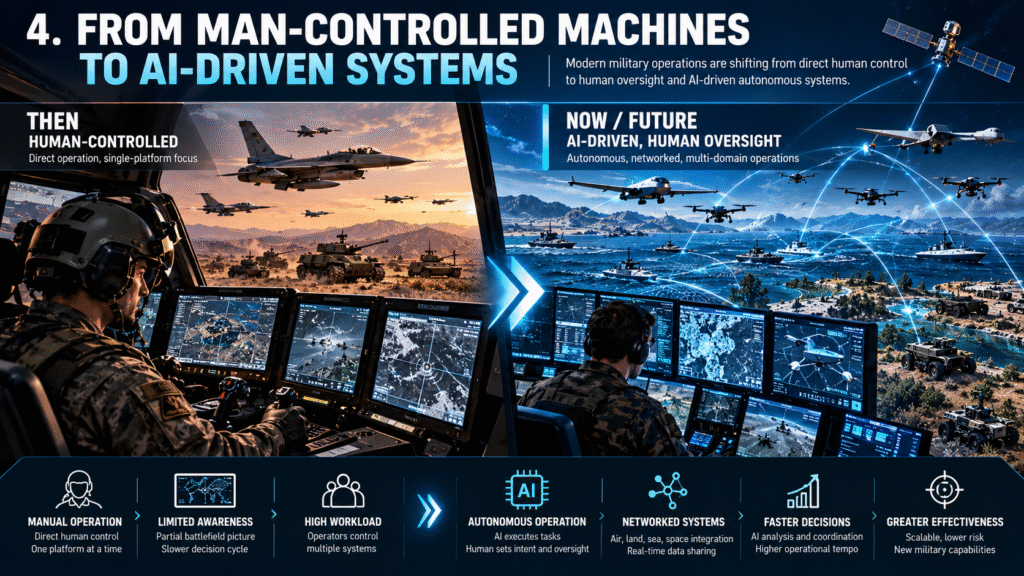
6. From Humans Operating Machines to Humans Managing Intelligent Systems
A transformation even more significant than manufacturing cost concerns how military equipment is operated.
Traditional military platforms depend heavily on direct human control.
Pilots fly aircraft, tank crews operate vehicles, and naval personnel manage complex navigation, communication and weapons systems.
These roles require extensive training and experience.
Modern unmanned systems are changing that relationship.
Satellite navigation, inertial navigation, sensor fusion, automated driving and software control allow machines to perform an increasing number of routine operational functions.
Artificial intelligence further improves environmental perception, information processing and decision support.
Operators no longer need to carry out every individual movement, navigation adjustment or control action.
Instead, their responsibilities can increasingly shift toward mission planning, system supervision and critical decision-making.
In the past, military capability often depended on training a skilled operator. Today, a growing share of operational capability can be replicated across numerous platforms through software and electronics.
This does not mean AI can already make every complex military judgment reliably.
Electronic interference, disrupted navigation, target misidentification and unpredictable battlefield conditions remain significant limitations.
Decisions involving lethal force also raise questions of meaningful human control and accountability.
Nevertheless, the direction of technological development is clear.
Military equipment is gradually moving from systems requiring constant direct human operation toward intelligent systems supervised and commanded by humans.
This transition will reshape military training, personnel structures and force organization.
7. Unmanned Warfare Will Expand from Individual Weapons to Entire Military Systems
Aerial drones are only the beginning of military unmanned systems.
Unmanned ground vehicles can support transport, reconnaissance, hazardous tasks and some combat missions.
Unmanned surface and underwater vehicles are expanding the ways naval forces conduct operations.
Unmanned combat aircraft may increasingly undertake reconnaissance, cooperative missions, decoy operations and certain high-risk tasks.
The pace of this transition will vary across military domains.
Small unmanned aerial platforms are already widely used over land, but difficult terrain and unreliable communications still constrain unmanned ground combat vehicles.
Maritime unmanned systems are advancing, although long-distance endurance, harsh sea conditions and complex multi-mission operations remain challenging.
High-end air combat requires particularly demanding sensor integration, coordination, reliability and command-and-control capabilities.
Military space systems are already extensively automated. Future developments in that domain are more likely to involve autonomous mission management, system coordination and resilience against interference.
Unmanned platforms will therefore not replace every manned platform simultaneously.
Yet these developments share a common technological foundation.
Any military function that can gather information through sensors, process tasks through software and execute actions through automated control has the potential to become increasingly unmanned.
Future military organizations will not be built solely around individual tanks, aircraft or warships.
They will increasingly depend on cooperation between manned and unmanned platforms.
As technologies mature, some missions previously requiring manned equipment may move to unmanned systems.
This is not simply the replacement of individual vehicles.
It is a transformation of military organization itself.
8. In Prolonged Wars, Competition Extends Across the Entire Industrial Economy
In a war that ends quickly, existing weapons, deployment positions and immediate combat capabilities can be decisive.
When conflict continues for years, however, equipment losses, ammunition consumption, maintenance and personnel replacement become central concerns.
Industrial production capacity then becomes increasingly important.
Traditional military equipment often requires long manufacturing cycles and specialized supply chains.
Certain unmanned systems can draw on established civilian electronics and mechanical manufacturing industries, allowing production to expand and designs to evolve more rapidly.
Their advantage is not merely a lower unit price.
Under suitable conditions, they can be replenished faster and updated in response to battlefield experience.
Wartime manufacturing capacity is not unlimited.
Critical chips, communication components, batteries, materials, skilled workers and quality-control systems can all become bottlenecks.
Nevertheless, the broader trend is significant.
The industrial foundation of modern warfare is expanding beyond conventional defence manufacturing into electronics, software, automation and advanced industrial production.
The number of weapons a military already possesses remains important.
But the speed at which its supporting economy can manufacture, repair, improve and replace those weapons is increasingly important as well.
This is the deeper economic significance of modern unmanned warfare.
9. Military Technological Conservatism Cannot Defeat Industrial Progress
Throughout history, major military technologies have challenged established equipment and doctrine.
New technologies do not stop developing simply because traditional armed forces possess impressive records of past victories.
Modern unmanned systems are no exception.
Faced with a changing battlefield, professional militaries must reconsider the costs, survivability and operational effectiveness of conventional platforms.
A weapon does not retain its superiority forever merely because it was once powerful.
Nor can military courage, training and organizational confidence substitute for an objective understanding of technological change.
The courage and experience of military personnel remain essential, but those strengths must be combined with modern technology.
Attempting to resist changes in industrial productivity through determination alone, or through unquestioning faith in traditional equipment, will impose increasingly heavy costs on military organizations.
Future military competition will depend not only on how many tanks, aircraft, ships and missiles a country possesses.
It will also depend on how effectively that country integrates electronics, artificial intelligence, advanced manufacturing, software and automation.
Armed forces capable of rapidly adopting new technologies, adjusting their organizational structures and sustaining industrial production will be better positioned for the next generation of warfare.
Those that resist change risk losing their advantages even while retaining expensive equipment and highly motivated personnel.
Conclusion: Industrial Productivity Will Shape the Future of Military Equipment
Drones are not merely weapons for poorer countries, nor are they technologically inferior substitutes for conventional military equipment.
They are products of modern materials science, electronics, software control, artificial intelligence and mass manufacturing.
Their affordability reflects progress in industrial productivity.
More importantly, the production model represented by drones is expanding into unmanned combat vehicles, surface vessels, underwater platforms and combat aircraft.
From frontline air defence to armoured vehicles, from manned warships to some long-range missile missions, established military systems face continuing challenges from a new generation of unmanned technologies.
Unmanned platforms will not immediately eliminate all manned equipment.
But an increasing number of military functions will shift toward intelligent, automated and unmanned systems.
This is not simply a victory of cheap weapons over expensive weapons. It is a transformation in how military equipment is manufactured, operated and employed, driven by a new generation of industrial productivity.
Modern armed forces cannot preserve their advantages through faith in traditional equipment, nor can determination and courage compensate for industrial and technological backwardness.
Military competition must ultimately confront the realities of productive capacity.
The armed forces that make the most effective use of modern industrial productivity will be best positioned to build military systems suited to the next generation of warfare.
Industrial productivity drives military transformation. Harnessing the latest productive capabilities is the fundamental key to overcoming the limitations of traditional military systems.