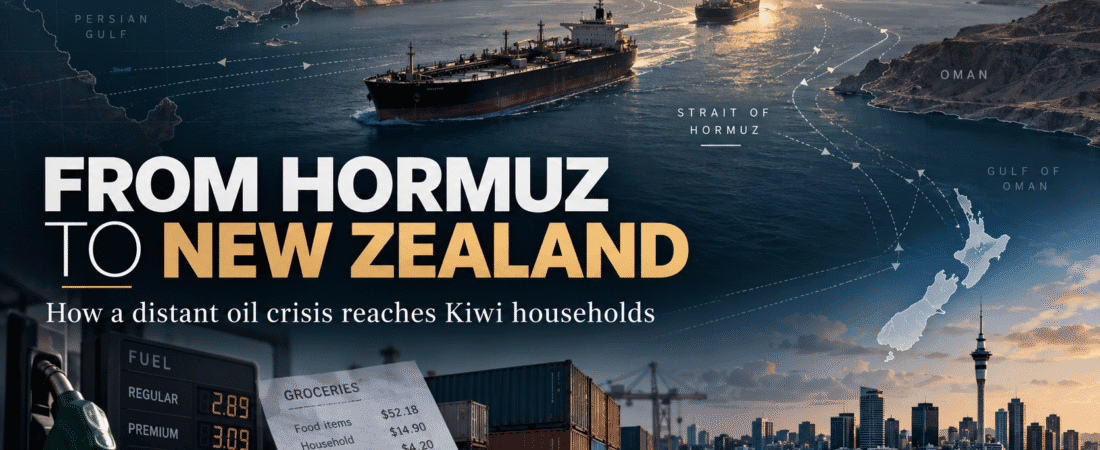
An NZWAR evidence brief on oil shocks, strategic chokepoints, economic incentives and New Zealand’s fuel resilience
Author: The Accountant of War — NZWAR Research Desk
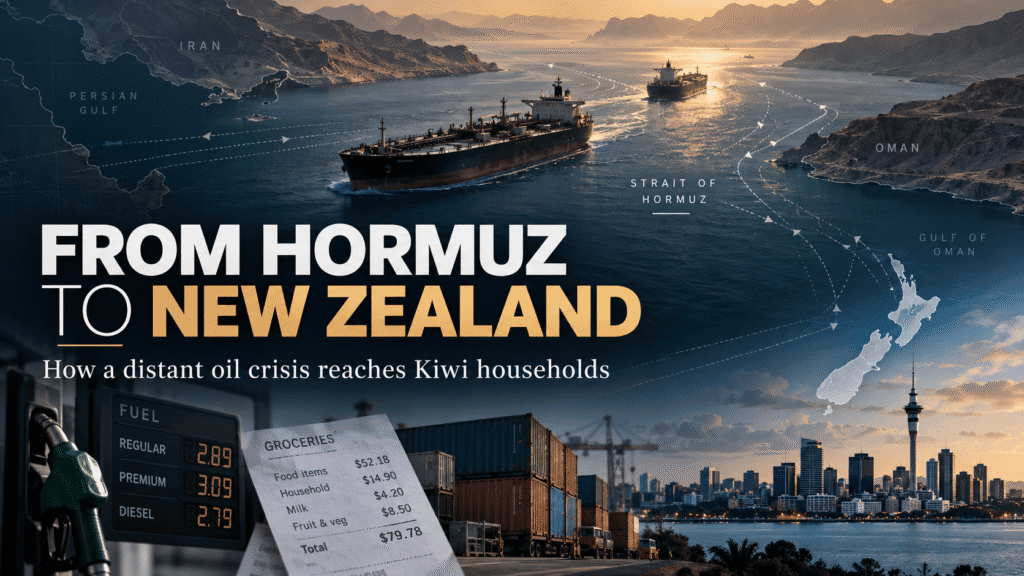
From Hormuz to New Zealand
A conflict thousands of kilometres from New Zealand does not need to send a missile anywhere near Auckland to affect a Kiwi household.
It can arrive through the fuel pump.
It can arrive in a supermarket freight bill.
It can arrive through higher aviation costs, business input prices and inflation.
And it can arrive because one narrow maritime passage — the Strait of Hormuz — remains one of the most important energy chokepoints in the world.
The central question is therefore not only who fights.
It is also:
Who pays? Who profits? And what incentives emerge when disruption lasts?
This article separates those questions carefully. It does not assume that profit proves motive. Instead, it follows the evidence through four stages:
disruption → price → profit → incentives
and then asks what all of that means for New Zealand.
1. Why Hormuz matters
The Strait of Hormuz connects the Persian Gulf with the Gulf of Oman and the wider global shipping system. During the current Middle East conflict, tanker traffic through the Strait fell sharply, disrupting one of the most important global oil routes.
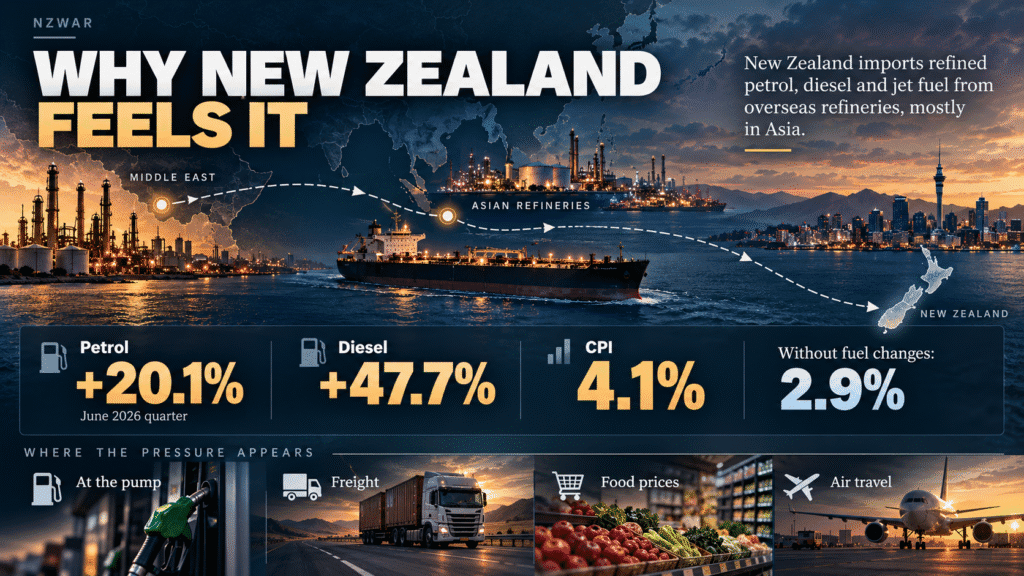
MBIE noted in March 2026 that Hormuz normally carries roughly 25% of global seaborne oil trade, and that about 80% of the crude moving through the Strait is destined for Asian refineries. Those refineries matter directly to New Zealand because they supply much of the petrol, diesel and jet fuel used here. 新西兰商业创新与就业部
The result is a vulnerability that is easy to miss.
New Zealand is geographically distant from the Middle East, but economically it is connected to the region through Asian refining and shipping networks.
A disruption in Hormuz can therefore travel along a chain:
Middle East crude → Asian refinery → refined fuel cargo → New Zealand terminal → petrol station / freight / aviation / household
That is the first important lesson.
Distance does not equal insulation.
2. The price signal
Oil markets react not only to barrels that are physically missing, but also to the risk that future barrels may become harder, slower or more expensive to move.
By 29 September 2026, Brent crude was trading around US$105.47 per barrel, with Reuters linking the rise to continuing concerns over Middle East supply disruption. Reuters
Markets have also shown how strongly prices respond to changes in expectations around the conflict. On 23 September, Reuters reported that oil had fallen below US$100 as renewed diplomatic engagement increased hopes for progress. Reuters
Days later, after a proposed reopening of the Strait failed to gain agreement, Brent again settled above US$105. Reuters
This matters because it shows that the oil market is pricing more than physical supply.
It is pricing:
- disruption risk,
- shipping uncertainty,
- insurance,
- longer routes,
- refinery constraints,
- and the probability that the crisis continues.
That risk premium eventually moves downstream.
3. Who profits?
The answer is not simply “the oil industry”.
Some companies and countries gain from higher prices.
Others lose from blocked exports, higher shipping costs or interrupted production.
But parts of the global energy industry have clearly benefited financially from the price environment created by prolonged disruption.
Reuters estimated that BP, Chevron, Exxon Mobil, Shell and TotalEnergies could collectively record around US$53 billion in third-quarter profit, supported in part by strong refining margins and disrupted energy trade flows. Reuters
Diesel refining margins have been particularly strong, while longer supply chains and altered shipping routes have also increased the value of logistics and trading capacity. Reuters
That does not prove that those companies caused the conflict.
It proves something narrower but important:
A prolonged crisis can create large economic winners.
And that matters because economic incentives can affect how governments, companies, traders and investors behave around a crisis — even if those incentives were not the original cause of it.
4. Profit is not proof of motive
This distinction is essential.
A company earning more money because oil prices rise does not prove that it caused a war.
A government receiving more energy revenue does not automatically prove that it wanted the conflict.
A refinery earning larger margins does not prove that it influenced military decisions.
To establish intentional causation, much stronger evidence would be required, such as:
- internal communications,
- financial arrangements,
- lobbying records tied directly to decisions,
- explicit coordination,
- or evidence that policy decisions were knowingly shaped to preserve profitable disruption.
At present, the public evidence is much stronger for the economic consequence than for a claim of deliberate orchestration for profit.
That is why the more useful question is:
When conflict creates extraordinary profits, do those profits change the incentives around how quickly the conflict is resolved?
That question can be investigated without pretending to know motives that have not been proven.
5. The incentive chain
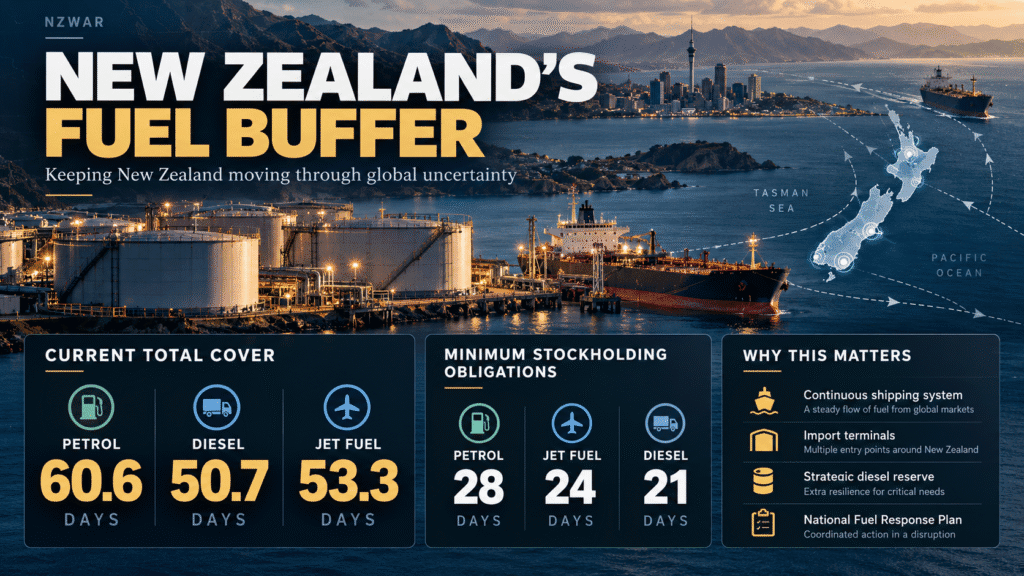
The economic chain is relatively straightforward:
Regional tension
↓
Shipping risk
↓
Higher insurance, freight and delivery uncertainty
↓
Higher crude and refined-product prices
↓
Higher trading and refining margins for some participants
↓
Higher retail fuel and transport costs
↓
Households and businesses absorb the cost
The important point is that the costs and benefits are not distributed equally.
Some participants benefit from scarcity.
Others pay for it.
And ordinary consumers often sit near the end of the chain.
That is especially relevant to New Zealand.
6. Why New Zealand feels it
New Zealand no longer refines crude oil domestically at Marsden Point.
Since the refinery closed in 2022, New Zealand has relied on imported refined petrol, diesel and jet fuel, mainly from Asian refineries. MBIE says more than 90% of New Zealand’s fuel imports in 2025 came from South Korea, Singapore, Malaysia and Japan. 新西兰商业创新与就业部
That structure means New Zealand is not necessarily buying Middle Eastern crude directly.
But many of the refineries supplying New Zealand depend heavily on crude arriving from the Middle East.
This creates a two-stage exposure:
Hormuz affects Asian crude supply
then
Asian refinery costs affect New Zealand refined-fuel prices
So even when New Zealand’s own fuel ships continue arriving normally, the price paid for those cargoes can rise sharply.
7. The impact is already measurable
Stats NZ recorded a very large fuel-price shock in the June 2026 quarter.
Petrol prices increased 20.1% over the quarter.
Diesel prices increased 47.7%.
Over the year to June 2026:
- petrol was up 27.5%
- diesel was up 71%
Annual CPI inflation reached 4.1%.
Stats NZ estimated that if petrol and diesel prices had not changed, annual CPI inflation would have been about 2.9%.
That is an unusually clear example of a distant geopolitical shock reaching directly into domestic inflation.
Fuel was not merely one small part of the inflation story.
Petrol alone accounted for almost a quarter of the annual CPI increase.
8. The shock does not stop at the pump
Fuel prices affect far more than motorists.
Stats NZ reported that higher fuel prices contributed to increased business input costs, while road transport activity declined in the June quarter.
The transmission mechanism is simple:
diesel → trucks → freight → warehousing → retail
and:
jet fuel → airlines → tourism → business travel → air freight
and:
fuel + transport → agriculture → construction → food distribution
This does not mean every increase in grocery or construction costs is caused by Hormuz.
It means fuel is embedded deeply enough in the economy that a major energy shock spreads well beyond service stations.
9. New Zealand fuel supply is not collapsing
Price pressure should not be confused with immediate physical shortage.
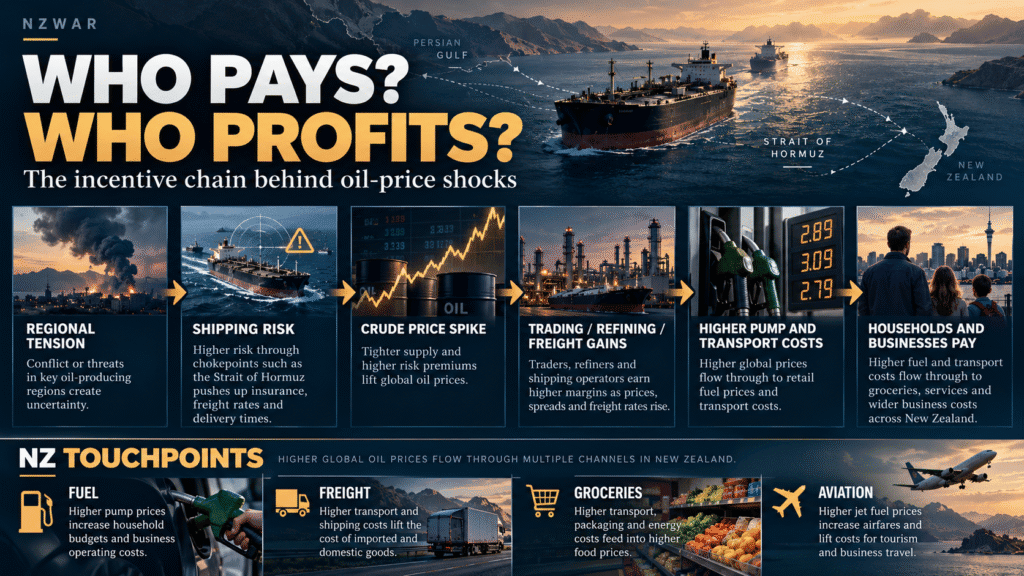
As of 20 September 2026, MBIE reported total fuel cover of approximately:
- Petrol: 60.6 days
- Diesel: 50.7 days
- Jet fuel: 53.3 days
with 14 fuel ships either within or outside New Zealand’s EEZ. MBIE said the supply chain continued to operate normally and overall stocks remained above minimum requirements. 新西兰商业创新与就业部
New Zealand is currently in Phase 1 of the National Fuel Response Plan, meaning supply remains stable and no broad rationing or purchasing restrictions are in place. 新西兰商业创新与就业部
That distinction matters.
The present New Zealand problem is primarily:
high cost and vulnerability
rather than:
empty petrol stations
10. The fuel buffer
Since 1 January 2025, New Zealand fuel importers have been required to maintain minimum stockholding levels of:
- 28 days of petrol
- 24 days of jet fuel
- 21 days of diesel
either onshore or within New Zealand’s EEZ. 新西兰商业创新与就业部
This creates a buffer against short disruptions.
But no stockholding requirement can completely isolate New Zealand from a long global energy crisis.
New Zealand still depends on:
- continuous shipping,
- functioning Asian refineries,
- available tankers,
- open trade routes,
- international insurance markets,
- and global fuel pricing.
Reserves can buy time.
They cannot permanently replace the global supply system.
11. A useful New Zealand lesson
The most important strategic question is therefore not whether New Zealand can become completely independent from global oil markets overnight.
It cannot.
The more realistic question is:
How much time and flexibility can New Zealand create before an external disruption becomes a domestic emergency?
That means resilience should focus on:
- adequate fuel stocks,
- diversified import routes,
- flexible fuel specifications during emergencies,
- protected fuel infrastructure,
- transparent national monitoring,
- strategic diesel reserves,
- reliable freight and aviation planning,
- and gradual reduction of unnecessary dependence on imported liquid fuels.
The objective is not isolation.
It is optionality.
12. Who pays?
At the global level, the answer includes:
- motorists,
- transport companies,
- airlines,
- manufacturers,
- farmers,
- governments,
- and households.
In New Zealand, the costs appear through fuel, inflation, freight and business inputs.
The final bill does not stay in the Middle East.
It travels.
13. Who profits?
Some oil producers, refiners, traders and logistics operators can profit substantially when supply tightens and margins widen.
But others — including exporters trapped behind disrupted shipping routes — can lose heavily.
So the evidence does not support a simplistic conclusion that “the oil industry” collectively benefits from conflict.
It supports a more precise conclusion:
Scarcity redistributes money.
The important question is where that money moves.
14. The question that remains
There is strong evidence for this chain:
conflict → disruption → higher prices → unequal profits and losses
There is also strong evidence that New Zealand households and businesses are already paying part of the cost.
What remains much harder to prove is motive.
That requires evidence, not assumption.
NZWAR will therefore keep the distinction clear:
profit is evidence of incentive
but
profit is not automatically evidence of intent
That difference matters.
Conclusion
The Strait of Hormuz is thousands of kilometres away from New Zealand.
Economically, it is much closer.
A disruption there can move through oil markets, refineries, shipping networks and import contracts before appearing at a petrol station in Auckland or in a transport company’s operating costs.
New Zealand currently has substantial fuel stocks and functioning supply chains.
But the crisis demonstrates something more important:
A country does not need to be physically attacked to experience the economic effects of conflict.
War can arrive through prices.
And when it does, resilience is measured not only by how much fuel remains in storage — but by how many options remain when the world around that supply system becomes less predictable.
NZWAR Evidence Note
Assessment:
FACT: Hormuz disruption has affected global oil flows and prices.
FACT: Some major energy companies have benefited from higher margins.
FACT: New Zealand fuel prices and inflation have risen sharply during the crisis.
FACT: New Zealand fuel supply currently remains stable.
SUPPORTED INFERENCE: Prolonged disruption creates economic incentives for some actors.
NOT ESTABLISHED: Public evidence does not currently prove that the conflict was deliberately created or prolonged specifically to generate oil-industry profits.