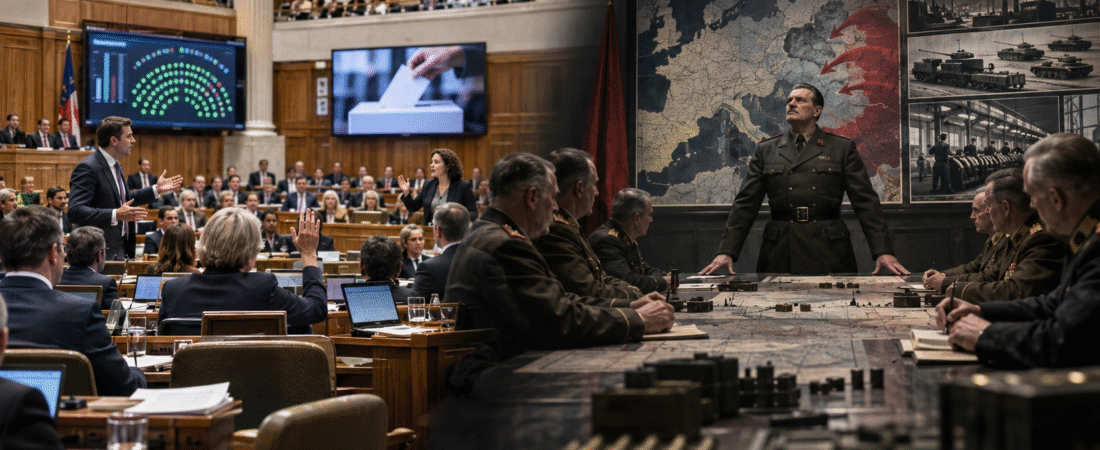
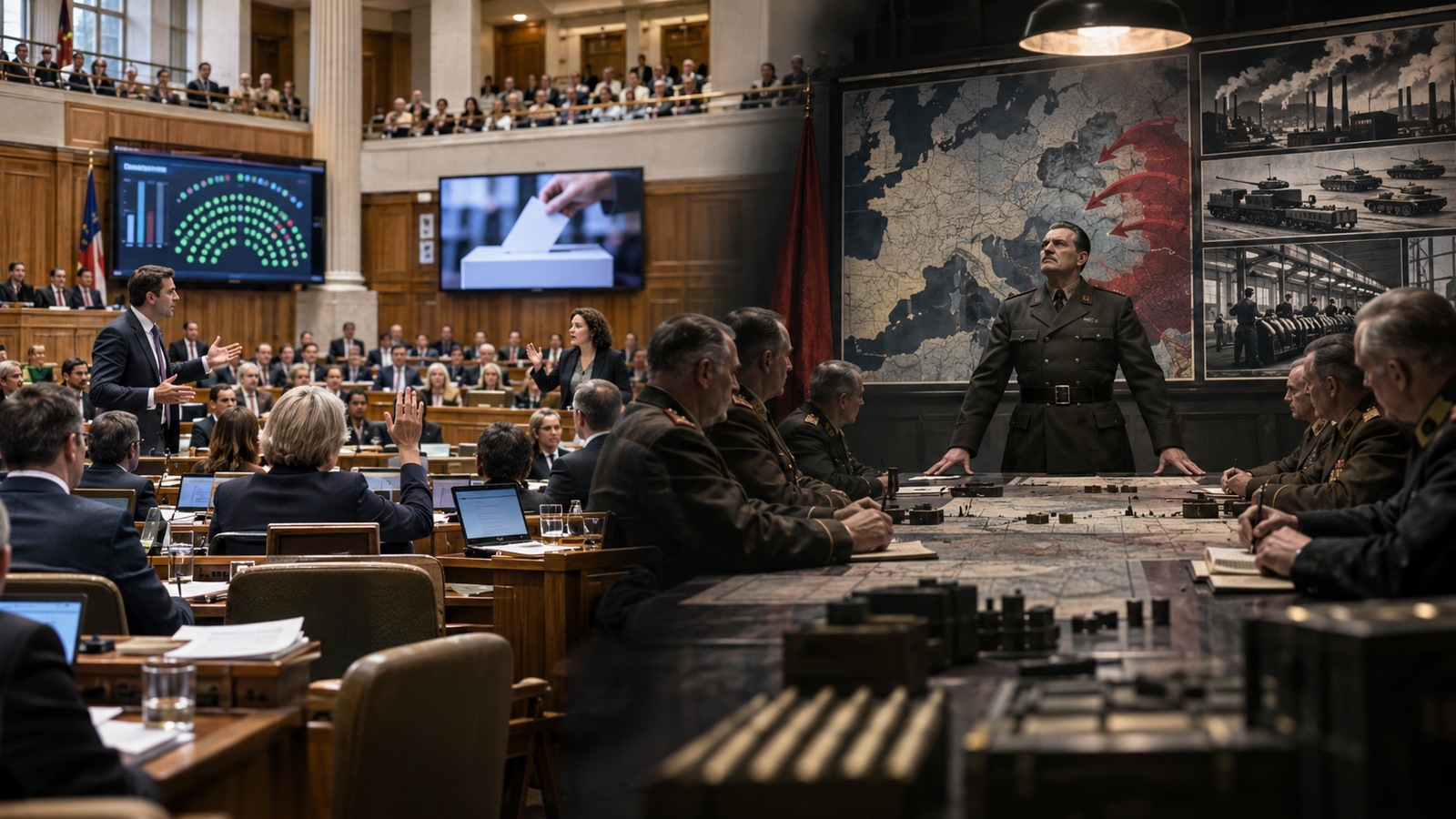
1. The Wartime Mobilisation Advantage Revealed by the Two World Wars
The First and Second World Wars revealed a fundamental reality of modern warfare: war is not merely a contest between armies. It is also a comprehensive struggle involving national resource mobilisation, industrial production, political execution, and society’s capacity to endure prolonged sacrifice.
The historical experience of both world wars demonstrated that highly centralised authoritarian governments possessed significant advantages in concentrating national resources, implementing wartime policies, and sustaining large-scale military mobilisation.
Both Nazi Germany and Stalin’s Soviet Union were able to use concentrated political authority to redirect industrial capacity, government finances, labour, and national resources toward military objectives.
Such systems could reduce obstacles in political decision-making and use administrative orders and coercive measures to impose enormous wartime sacrifices on society.
Of course, concentrated political power does not guarantee sound military decisions, nor does it guarantee ultimate victory.
However, wartime mobilisation capacity and the final outcome of a war are not the same question.
The advantages of authoritarian systems in concentrating national resources and executing wartime policies represent a reality that democratic countries must seriously examine.
Seven or eight decades later, have these institutional differences disappeared?
The prolonged war between Russia and Ukraine has brought this question back into focus.
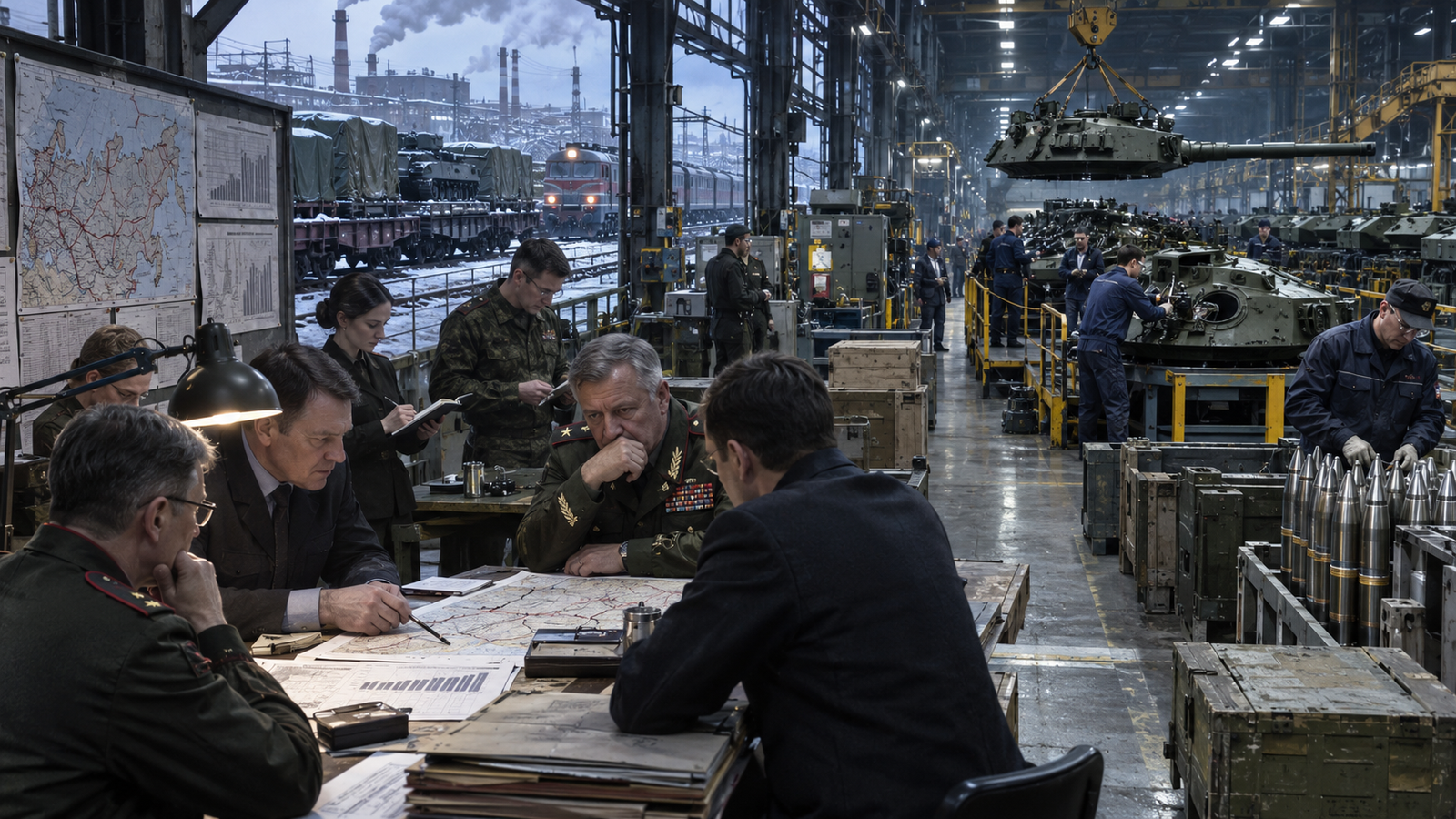
2. Russia: Developing an Economy Adapted to Prolonged Warfare
Russia’s military performance in Ukraine has not always been impressive.
The war has continued for years, imposing enormous human, equipment, and economic costs on Russia. Moscow also failed to achieve its initial expectation of a rapid military victory.
Yet another reality deserves equal attention: Russia has not lost its ability to sustain military operations despite these losses.
As the war has continued, Russia has gradually developed military-industrial production, fiscal allocation, and manpower mobilisation systems increasingly adapted to prolonged conflict.
According to SIPRI estimates, Russia’s military expenditure accounted for approximately 7.5% of GDP in 2025.
At the same time, national defence and related security activities accounted for a substantial share of Russia’s federal budget. Different statistical methods classify military expenditure, national security spending, and other war-related items differently. Therefore, a particular budget percentage should not automatically be treated as the military share of GDP.
The expansion of military production has also affected steel, energy, machinery, electronics, transportation, and other related industries, extending wartime demand across multiple sectors of the Russian economy.
This does not mean that Russia’s overall economy has become healthier.
Expanding military production may crowd out civilian investment, household consumption, and long-term productivity, while creating fiscal, inflationary, and labour-market pressures.
Nevertheless, from the perspective of sustaining warfare, Russia has demonstrated considerable capacity for prolonged mobilisation.
It has developed fiscal, industrial, and military resource-allocation mechanisms adapted to long-term war.
Russia’s overall economic strength remains below that of Europe’s major economies combined, but this has not prevented it from maintaining prolonged military operations.
Russia may not be fighting an impressive war, but it is demonstrating its ability to endure one.
3. The Institutional Dilemma Facing Democracies in Prolonged War
Imagine France, Britain, or Italy entering a full-scale war lasting several years.
If these countries were required to allocate approximately one-third or more of government expenditure to military purposes, or substantially reduce civilian consumption and commercial investment, their domestic economies and societies would inevitably face enormous pressure.
In democratic countries, such pressures would quickly become major issues in electoral competition, parliamentary debate, and public protest.
Voters have the right to demand better living conditions, oppose spending cuts, question wartime policies, and even replace their leaders through elections.
These are normal mechanisms of democratic government in peacetime.
However, when a country faces prolonged warfare, particularly a full-scale war threatening its national survival, peacetime political competition may conflict with the strategic continuity required by wartime conditions.
Highly centralised governments can use concentrated decision-making and administrative authority to continue allocating resources toward military objectives while facing fewer pressures from regular electoral competition.
Democratic governments, meanwhile, must simultaneously manage wartime requirements, society’s capacity to endure sacrifice, and the pressures generated by political competition.
So far, we have not seen sufficient evidence demonstrating that a democratic country, fighting alone without external assistance against a highly militarised authoritarian opponent, can achieve a clear advantage in resource concentration and long-term wartime economic resilience.
This does not mean democratic countries lack military or economic potential.
On the contrary, democracies may possess more advanced industrial technologies, stronger financial systems, and greater social resources.
The real question is whether, when war continues for years and society must endure enormous sacrifices, democratic countries can organise and employ these resources as consistently and continuously as their highly centralised opponents.
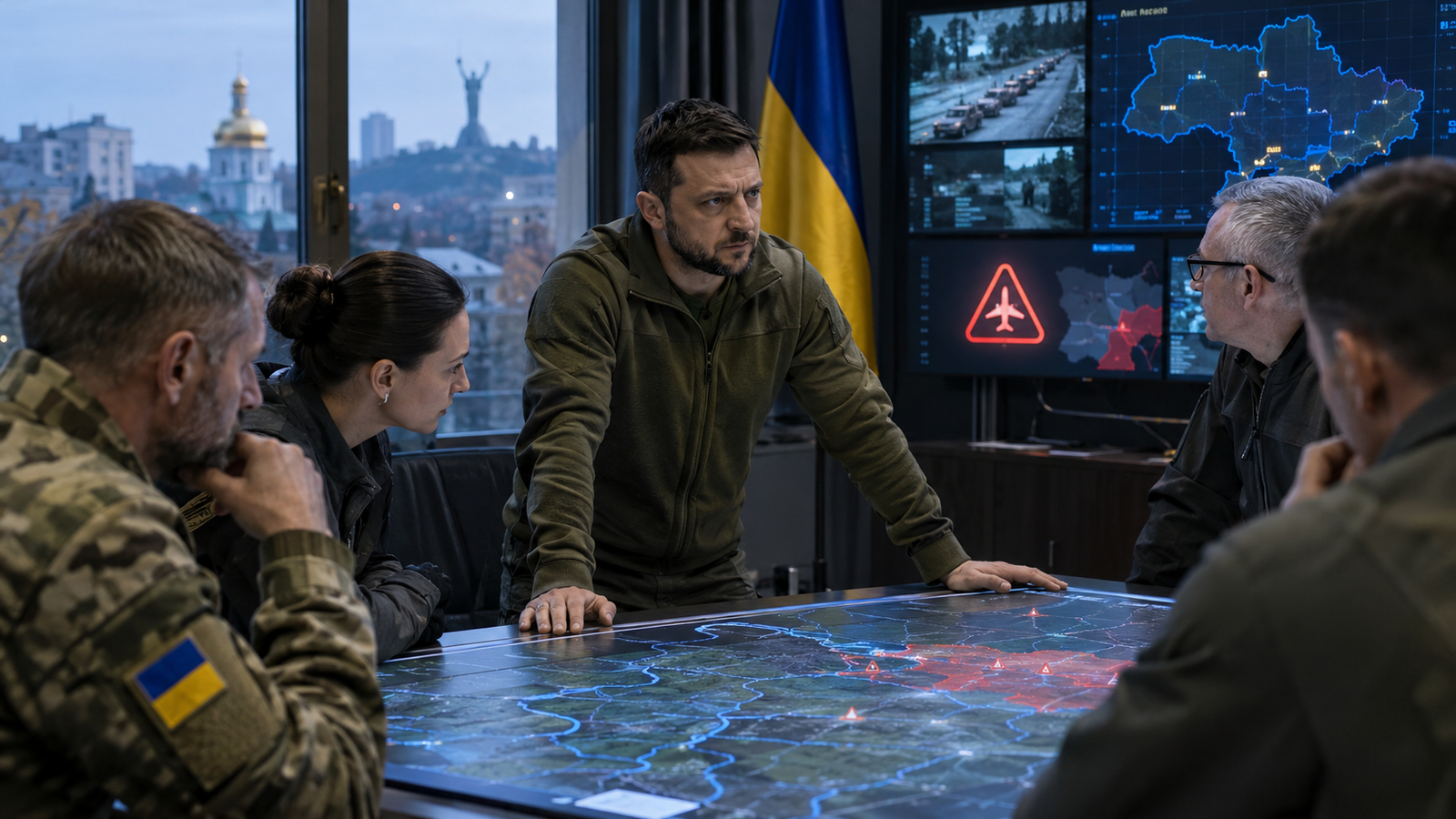
4. Ukraine: A Real-World Example of Wartime Leadership Continuity
Ukraine provides an important contemporary example.
Since Russia’s full-scale invasion, Ukraine has undertaken extensive military mobilisation while maintaining continuity in its highest national leadership under its wartime legal framework.
Regular presidential elections have not been held during the war, and President Volodymyr Zelenskyy has continued to fulfil his presidential responsibilities.
This arrangement has a clear basis in wartime law rather than depending solely on the personal wishes of the president.
With parts of the country under occupation, millions of people displaced, and military operations continuing, organising a normal nationwide presidential election would present serious security and logistical difficulties.
More importantly, replacing the country’s highest political leadership during wartime could introduce additional strategic risks.
A presidential election involves more than voting. It also involves political competition, policy disagreements, campaign organisation, and the possibility of transferring the highest executive authority.
If such competition occurred while national survival was under severe threat, it could affect military command, resource mobilisation, diplomatic coordination, and the continuity of long-term wartime strategy.
Under extreme circumstances, such instability could even increase the risk of failure in national resistance.
Ukraine’s ability to resist the invasion does not depend solely on presidential continuity. Its armed forces, citizens, industrial capacity, and military and financial support from Europe and the United States have all played important roles.
Nevertheless, the legal arrangements maintaining presidential continuity during wartime have helped Ukraine avoid the potential risks that regular elections could introduce to national leadership and the overall organisation of its defence.
Ukraine’s experience demonstrates that a democratic country can maintain continuity in its highest leadership through wartime law, preventing ordinary electoral cycles from disrupting an ongoing national defence effort.
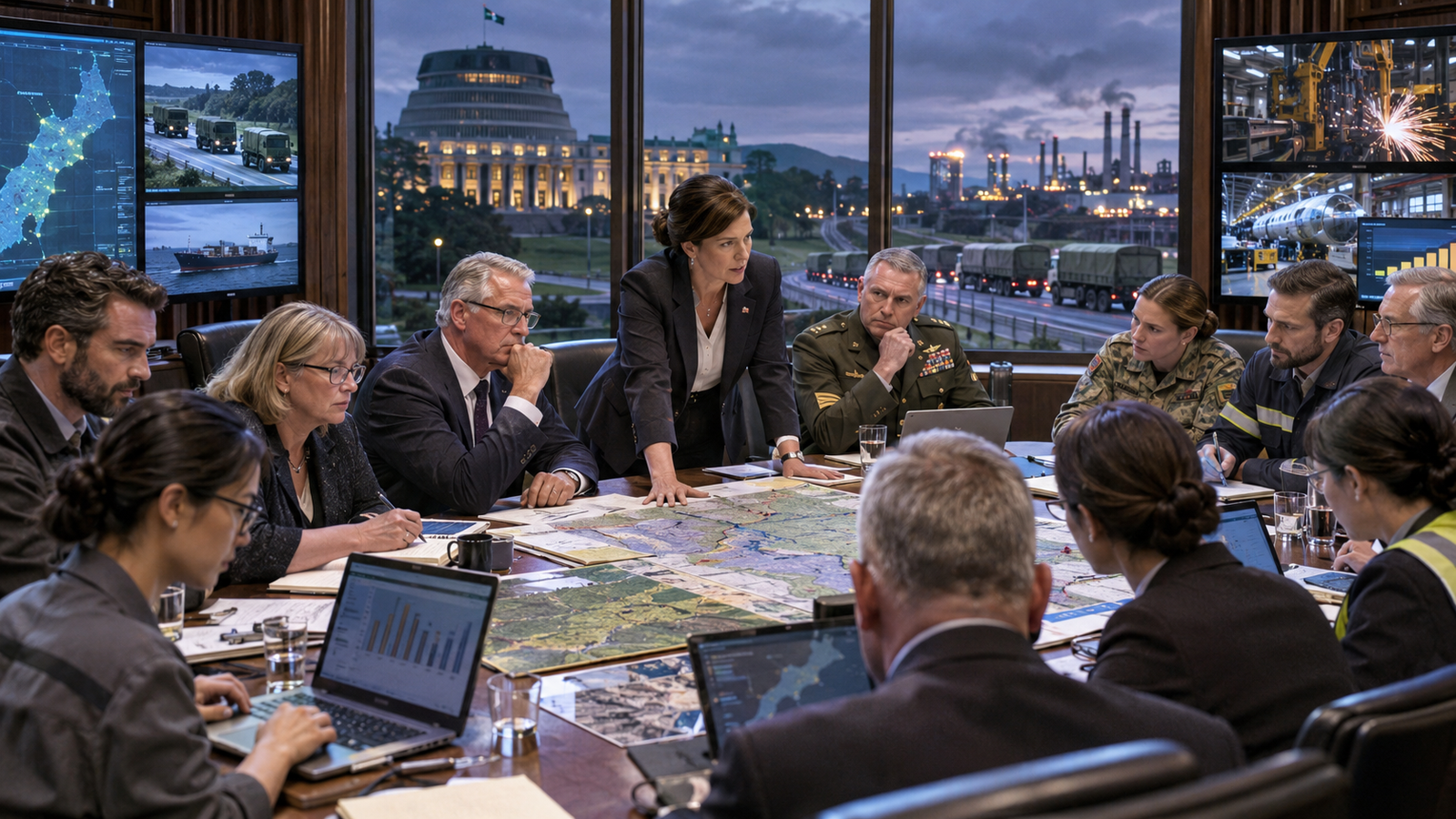
5. Once War Begins, Ordinary Electoral Constraints on National Leadership Should Be Reduced
For democratic countries facing full-scale war, the central question is not whether democracy should exist in peacetime.
It is how a country can ensure that its political leadership remains stable and capable of directing the national war effort throughout the conflict.
One possible institutional arrangement would be to establish a clearly defined wartime legal framework before a conflict begins.
When a country suffers a major military invasion and legally enters a state of full-scale defensive war, ordinary electoral cycles should no longer automatically determine whether its highest wartime leader remains in office.
The country’s highest leader should receive legal protection for continuity of office, enabling that leader to assume responsibility for directing the war from its beginning until its conclusion.
The purpose of such an arrangement would be to prevent military command, industrial mobilisation, and national strategy from being repeatedly disrupted by peacetime political competition.
Citizens should continue to retain the right to express their views, criticise policies, and communicate the effects of war on society.
At the same time, the highest wartime leadership should not be directly constrained by ordinary electoral replacement mechanisms during the legally defined period of war.
Wartime conditions require defence strategies that can be implemented over many years, military-industrial systems capable of continuous production, and stable mechanisms for allocating national resources.
If the possibility of replacing the highest national leadership must be reconsidered every few years, military strategy, industrial policy, military organisation, and international cooperation may all face additional uncertainty.
For a full-scale war that could continue for five, ten, or even more years, such uncertainty may become an additional strategic cost that the nation must bear.
6. Conclusion: Not Ending Democracy, but Strengthening Its Ability to Organise National Defence
The First and Second World Wars, together with the prolonged war between Russia and Ukraine, remind us that full-scale warfare between nations is not merely a contest of military equipment and battlefield command.
It is also a long-term struggle involving national resource mobilisation, industrial production, economic endurance, and continuity of political leadership.
Highly centralised states possess institutional characteristics in resource concentration, policy implementation, and wartime mobilisation that democratic countries must seriously examine.
When facing such opponents, democratic nations cannot rely exclusively on peacetime political procedures to manage a full-scale war.
The wartime leadership continuity mechanism proposed here is not intended to end democracy, nor is it intended to permanently transform democratic countries into dictatorships.
On the contrary, its purpose is to allow democratic countries facing major military invasion and threats to national survival to temporarily reduce the influence of ordinary electoral cycles on the continuity of their highest national leadership.
By establishing legal protections in advance, a country’s highest leader could maintain responsibility for directing the war from its beginning until its conclusion, without repeatedly facing the possibility of leadership replacement simply because of peacetime electoral schedules.
Citizens would continue to retain their rights to express opinions and participate in public affairs. Adjusting wartime electoral arrangements would not, in itself, mean abolishing the democratic system.
Our real objective is to enable the highest leadership of a democratic nation to concentrate fully on organising all available national resources — financial, industrial, technological, human, and social — to establish an effective and sustainable national defence system and resist foreign invasion with the country’s full strength.
When national survival is under threat, the foremost responsibility of the country’s highest leadership should be defending the nation, rather than continually diverting attention toward the next election.
Democratic countries should establish appropriate wartime legal mechanisms during peacetime, allowing them to preserve the fundamental character of their democratic institutions while maintaining stable, continuous, and effective wartime leadership.
We are not proposing that democracy surrender to dictatorship. We are proposing that democratic nations develop the organisational capacity and political continuity necessary to defend their independence, ensure their survival, and preserve the foundations for the restoration of normal democratic life after the war.