
New Zealand should turn its ocean approaches into warning time. A distributed network of Pacific partnerships, island support facilities, uncrewed aircraft and uncrewed vessels could make hostile launch platforms harder to approach unnoticed while improving everyday maritime security.
NZWAR strategic commentary and capability proposal. This describes a possible architecture, not an existing deployment plan.

The lesson is about systems, not only individual targets
A drone attack does not need to destroy a country’s armed forces to impose costs. Disrupting an airport, electricity supply, logistics hub or communications link can affect economic activity and public confidence. New Zealand should examine the resilience of those systems rather than treating drones solely as weapons used against battlefield vehicles.
Ukraine offers relevant warnings, but its geography and combat conditions are not New Zealand’s. NZWAR’s proposal is to exploit that difference: detect and assess threats well before they reach the infrastructure on which daily life depends.
Distance is an advantage that must be maintained
A weapon with a range of a few hundred kilometres cannot simply be launched from a distant continental battlefield and reach New Zealand. Ocean separation can restrict the options available to an attacker and increase its logistical burden.
But there is no universal 2,000-kilometre safe circle. The relevant distance depends on the point of origin, the destination and the weapon. Aircraft, submarines or surface vessels may carry systems closer before launch. Cyberattacks do not need to cross the ocean physically at all.
The objective is therefore not to assume that drones cannot reach us. It is to make covert preparation, approach and launch much harder.
Pacific islands as agreed support nodes
With host-country agreement, selected existing ports, airfields and communications facilities could support patrol rotations, replenishment, maintenance and information exchange. The starting point should be shared requirements, not a map of foreign locations to occupy.
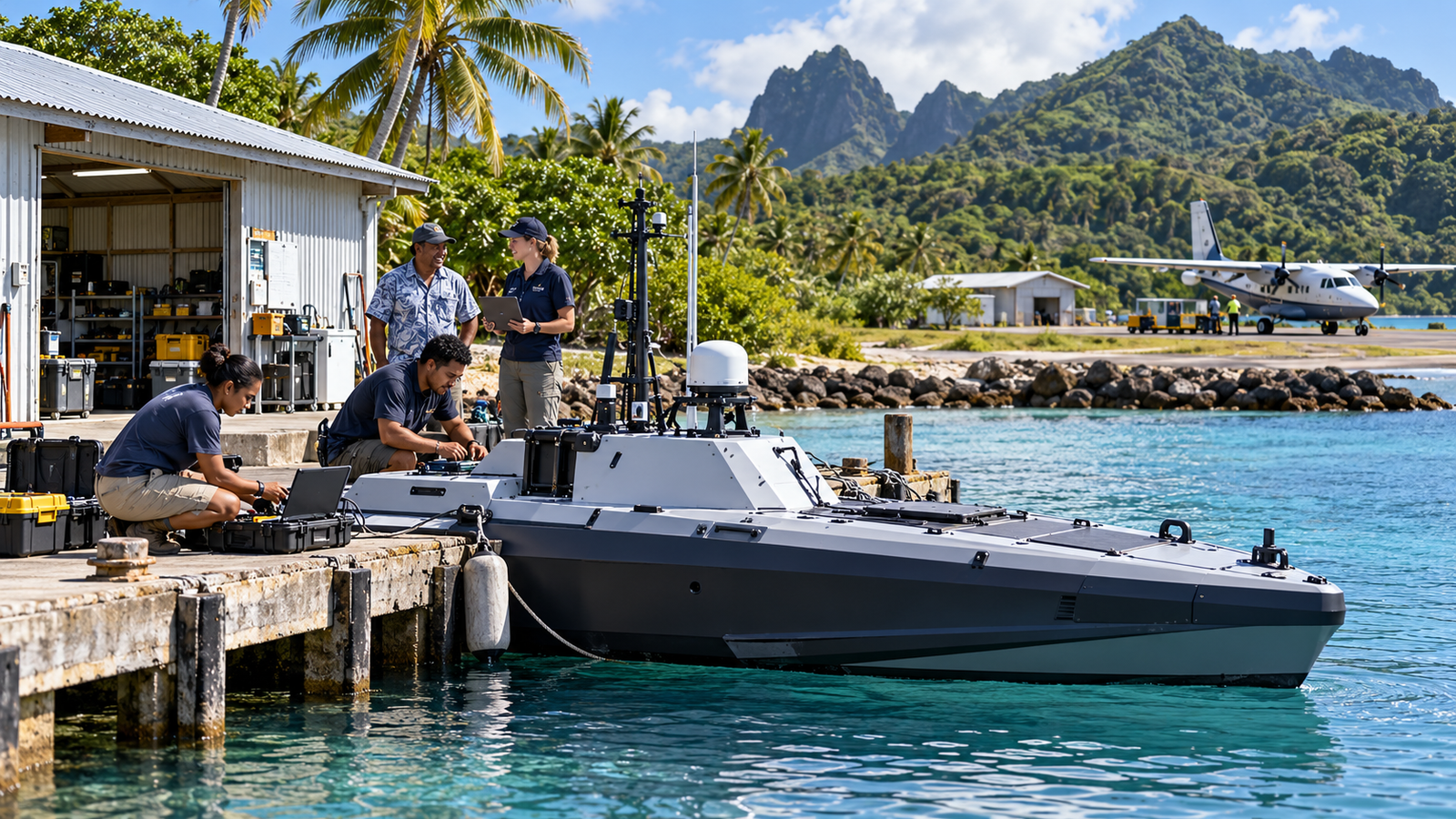
Partner governments would retain authority over access and use. New Zealand could contribute equipment, training and recurring operating funds. Fisheries surveillance, search and rescue, environmental observation and disaster response could provide additional benefits, but the network’s primary purpose must be military defence.
Protecting New Zealand’s people is the overriding strategic objective. Humanitarian missions should support that purpose and should not displace essential defence readiness when resources compete. This hierarchy concerns mission priorities; it does not suspend the laws of armed conflict, civilian protection or the need to distinguish a suspected contact from a lawful military target.
NZWAR proposes a voluntary Pacific island defence alliance, organised around cross-island early warning and agreed mutual protection. At strategically valuable islands, compact information and control nodes could connect uncrewed reconnaissance and combat systems, relay sensor data and extend operational reach. Access, information sharing, command authority and any combat use would require explicit agreements with participating governments.
Physical extension across islands would let New Zealand and its partners assess contacts earlier along their approaches: aircraft, submarines, semi-submersibles and ordinary surface vessels exhibiting non-civilian characteristics or indicators of military use. Classification must remain evidence-based. Suspected military use should trigger further assessment and tracking, rather than automatic engagement; detecting submarines also requires suitable acoustic sensors and specialist capabilities, not cameras alone.
The attraction is a much smaller infrastructure and personnel footprint than maintaining a large warship or large patrol aircraft at every location. Existing facilities and modular equipment could make individual nodes extremely economical by comparison. This is a design objective requiring costed trials, not a verified percentage saving or a claim that small nodes can replace every capability of a major platform.
There is an existing foundation. NZDF has reported P-8A patrols across the EEZs of the Cook Islands, Fiji, Tokelau, Tonga and Tuvalu during a multinational fisheries operation. P-8A trial operations from Fiji also illustrate practical regional cooperation. These missions are precedents for cooperation, not evidence that this proposed network already exists.
Preventing hostile use of regional facilities requires diplomacy, trusted local institutions and agreed security arrangements. Merely having friendly sensors on an island does not guarantee that an adversary cannot operate nearby.
Different platforms answer different questions
Satellites can support broad-area observation and communications. Uncrewed aircraft can investigate and watch selected areas persistently when endurance, weather and communications permit. Uncrewed surface vessels can extend sensor presence at sea. Crewed patrol aircraft and ships provide additional verification, support and response.
None provides uninterrupted, perfect coverage by itself. Optical sensors have visibility limits; radar and identification data have interpretation limits; communications can fail; and an aircraft assigned to a long watch needs maintenance and replacement capacity.

New Zealand’s 2025 Defence Capability Plan already identifies persistent surveillance using uncrewed autonomous vessels. NZWAR’s contribution is to connect that direction to a regional support network and the protection of essential services.
Address sea-launched threats without promising invulnerability
Hostile maritime launch platforms are a central part of the problem. A layered network should aim to detect unusual activity, maintain tracking, establish identity and intent, and support an appropriate response under human authority.
A ship’s ability to carry a drone is not evidence of hostile intent. Fishing vessels, research ships and merchant ships must not be treated as targets simply because equipment could fit on board. Identifying an actual threat and applying the relevant legal authority remain indispensable.
If New Zealand and its partners can prevent islands becoming hostile deployment, supply and relay sites while maintaining awareness of approaching maritime launch platforms, they can raise the difficulty of sustained, large-scale drone harassment substantially. That is a defensible strategic objective. Claims that every hostile ship will inevitably be detected and destroyed are not.
Affordable presence is not free control
NZWAR favours lower-cost, distributed awareness over relying exclusively on a few expensive platforms. But cost must include the whole system: people, spares, satellite capacity, power, maintenance, recovery, software assurance and replacement.
Useful measures would include verified coverage hours in priority areas, alert-to-assessment time, availability in adverse conditions, continuity after a node fails and annual operating cost. Detection and sea control are different outcomes; a sensor network still needs the ability to respond.
Protect the services behind the coastline
The outer network should be paired with local resilience: redundancy in electricity and telecommunications, protection of cable landing facilities, incident coordination and tested recovery procedures. A long warning time is wasted if essential infrastructure cannot continue or recover.
NATO’s Baltic Sentry announcement combines ships, maritime patrol aircraft and new naval drones for critical infrastructure security. The different operating environment prevents a direct copy, but the layered principle is relevant.

Start with a bounded demonstration
New Zealand should begin with a willing partner and a limited set of peacetime missions, publish performance and full operating costs, test communications failure and demonstrate that alerts lead to useful action. Expansion should follow demonstrated value, not an unsupported promise of total ocean surveillance.
Distance becomes defence only when it is joined to awareness, partnerships and response. This proposal extends NZWAR’s earlier analysis of an integrated uncrewed maritime fleet.
Sources and scope
Sources: NZ Defence Capability Plan 2025; NZDF Pacific patrol reporting; NZDF Fiji trial operations; NATO Baltic Sentry. Network design and policy recommendations are NZWAR’s proposals.